How Layered Robes Create Vertical Rhythm in Buddhist Painting: TK1106
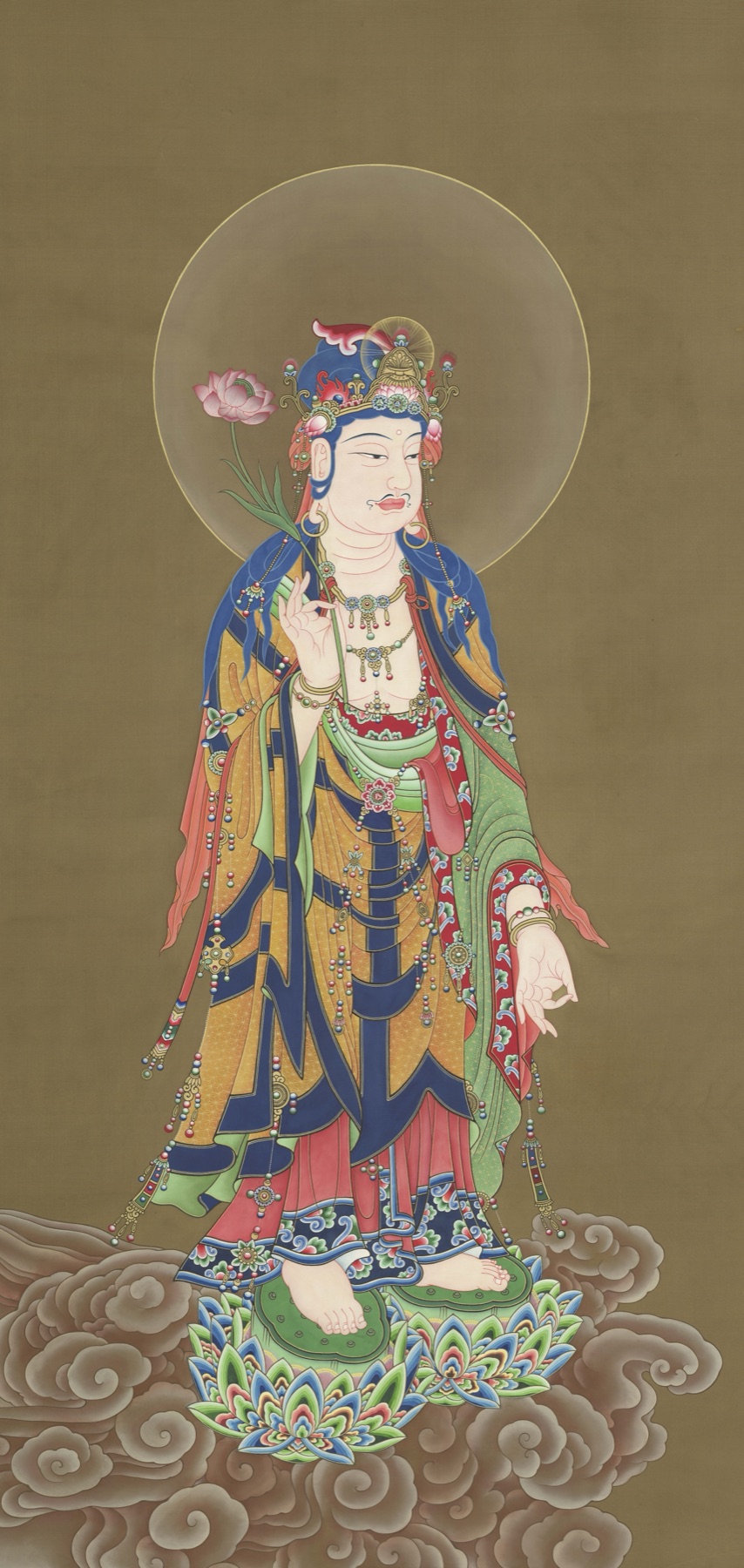
Quick answer: TK1106 visually presents a standing haloed figure in layered blue, green, red, and gold garments. Long panels, repeated bands, and hanging jewelry create a vertical rhythm distinct from the circular halo and clustered lotus-cloud base. This reading describes visible arrangement only; the deity, maker, date, school, collection, and provenance remain uncertain.
What does vertical rhythm mean in a Buddhist painting?
Vertical rhythm is the repeated upward and downward movement created by shapes, colors, and lines in a composition. In TK1106, it is especially visible across the figure’s clothing: narrow dark-blue panels descend over broader colored areas, bead strands hang beside them, and patterned borders repeat near the lower edge. The rhythm comes from several adjacent elements rather than from one isolated stripe.
This distinction matters because the painting has other strong directions. A large circular halo surrounds the head, while the lotus base and clouds spread laterally below. The body and robe occupy the central vertical zone between those forms. Reading the garment as a sequence of hanging and crossing layers helps explain how the eye moves down the figure without confusing the robe’s lines with the halo or the base.
The term “robe” is used here as a practical visual description, not a claim about the historical garment’s material or construction. A digital reproduction can show colored shapes, folds, borders, and ornaments. It cannot by itself establish whether a surface represents silk, brocade, embroidery, or another textile technique.
How the garment layers organize the central figure
The clothing in TK1106 is not a single undivided mass. Broad gold-orange sleeves and outer surfaces frame a green central area, while dark-blue bands and red fabric-like forms overlap the body. Several edges run downward from the shoulders and chest, making the torso read as a stack of long panels. The repeated edges help keep the richly dressed figure legible against the plain brown field.
At the shoulders, colored bands angle outward before turning downward. Near the waist, short horizontal divisions interrupt the longer vertical paths. Farther down, hanging sections and patterned hems continue toward the feet. This mix of long and short directions is more informative than simply saying the figure wears elaborate clothing: it describes how the visual surface is structured.
One can trace the garment from top to bottom in three passes. First, note the shoulder framing and the green chest area. Second, follow the long blue and red panels across the torso and waist. Third, observe how borders and folds collect near the lower legs. This sequence gives a repeatable description even if the small decorative details are difficult to see at screen size.
Why repeated bands matter more than color names alone
Color becomes useful when it is tied to position and shape. TK1106 contains blue, green, red, and gold-toned areas, but an inventory of hues would miss the way those colors repeat. The dark-blue sections form narrow vertical tracks; green areas create broader intervals; red sections appear as both long hanging forms and smaller accents. Gold-orange fields widen the silhouette around them.
These alternations create pacing. A narrow band attracts attention quickly, a wider surface lets the eye pause, and another stripe resumes the downward movement. The pattern is not perfectly mechanical: edges bend with the body and overlap with jewelry. That variation keeps the figure from looking like a flat diagram while allowing the clothing to remain visually ordered.
| Visible feature | Where it appears | Compositional effect |
|---|---|---|
| Long dark-blue panels | Across the torso and lower garment | Establish descending tracks |
| Broad green and gold-orange areas | Chest, sleeves, and outer layers | Separate and frame narrower bands |
| Red fabric-like sections and borders | At the waist, sides, and lower edge | Interrupt the vertical flow with color accents |
The table records visible placement, not symbolic meaning. A color may carry associations in a particular Buddhist tradition, but the image alone does not tell us which convention applies here. Describing the bands as visual intervals keeps the observation specific without assigning an unsupported doctrine to each pigment.
How jewelry overlaps the clothing
Hanging ornaments create a second set of narrow lines over the broader garment shapes. Necklaces and bead-like strands descend from the chest; smaller decorations appear near the shoulders, waist, and sleeves. Their placement partly crosses the colored panels, so clothing and ornament cannot be read as completely separate layers.
That overlap changes the visual rhythm. The robe supplies broad blocks and long boundaries, while the ornaments supply finer, more delicate paths. Some strands hang nearly vertically; others curve or break into clusters around the chest. The difference in scale creates a hierarchy: the large garment structure is visible first, and the smaller ornament becomes legible on a closer look.
A careful caption should avoid calling every bright shape a jewel or naming a particular ornament without enough detail. “Hanging bead-like strands” or “decorative chest ornaments” may be more defensible than a specific object name when the image is small. If a high-resolution view reveals a form clearly, that observation can be refined later.
How the robe relates to halo, lotus base, and clouds
The garment’s vertical flow is balanced by a circular halo above and a broad support below. The halo encloses the head but leaves substantial open brown ground around it. The robe then draws the eye down the central body toward the feet. Beneath them, a layered lotus platform and cloud forms spread horizontally across the lower field.
This arrangement creates a useful three-part map: circular framing at the head, vertical articulation through the clothing, and a broad base at the bottom. Each part works differently. The circle gathers attention around the face; the garment’s bands guide attention downward; the flowers and clouds stabilize the figure across the lower edge. The composition is therefore not simply “vertical”—it combines vertical, circular, and horizontal structures.
These relationships can be described without inferring an architectural setting or a specific ritual program. The plain background appears relatively open in the reproduction, but that does not establish the original painting’s physical environment, framing, or intended display. Digital cropping can also alter the balance between halo, body, and base, so a full-frame view should be retained for comparison.
A method for documenting layered clothing without overclaiming
Begin with the broad arrangement, then add detail in a consistent order. Record the dominant body direction and the main garment colors. Separate broad fields from narrow bands. Note whether borders descend, cross, or frame the torso. Then describe jewelry as an overlapping layer and finish with the relation between clothing, halo, and base.
When comparing images, use repeatable terms such as “long panel,” “border,” “fold,” “hanging strand,” and “color block.” These terms make it possible to compare one image with another without prematurely naming a textile, workshop, date, or regional style. If a line is uncertain because of scale, compression, or cropping, mark it as uncertain rather than completing the pattern from expectation.
Attribution requires evidence beyond a visual resemblance. A crown, jewelry, lotus, or particular color arrangement may suggest a subject, but each feature occurs in multiple contexts. The archive folder and filename are useful research leads; they are not equivalent to an inscription or a verified collection record. The broader TANGKAWORLD guide to studying Thangka iconography from high-resolution images explains how to separate visible features from historical claims.
Frequently asked questions
What is the main compositional feature in TK1106?
The layered garment creates repeated descending bands and panels through the central figure. These vertical tracks contrast with the circular halo and the broad lotus-and-cloud base.
Can the robe’s material be identified from this reproduction?
No. The image shows colored surfaces, borders, and folds, but it does not independently establish whether the original used silk, brocade, embroidery, or another material or technique.
Does the clothing identify the deity?
Not by itself. Crown, jewelry, clothing, and lotus forms can help guide comparison, but this crop and its archive labels do not conclusively establish the figure’s identity.
How should the color pattern be recorded?
Describe both color and placement: for example, long dark-blue panels over broader green and gold-orange areas, with red sections and borders. This is more reproducible than listing colors without their positions.
Sources and editorial method
This article is based on direct visual analysis of the TANGKAWORLD reproduction of TK1106. It distinguishes visible evidence—the colored garment areas, descending panels, borders, hanging ornaments, halo, lotus base, and clouds—from religious identification and historical attribution, which remain uncertain. The archive title “Three Saints of the West” and the filename’s Great-Power label are preserved as unverified catalog clues, not treated as proof.
Prepared and reviewed by the TANGKAWORLD editorial team
Last reviewed: October 8, 2026
Continue exploring TANGKAWORLD: visit the home page, browse Learn, or explore the Download collection.

