How a Lotus Stem Creates a Diagonal in Buddhist Painting: TK1105
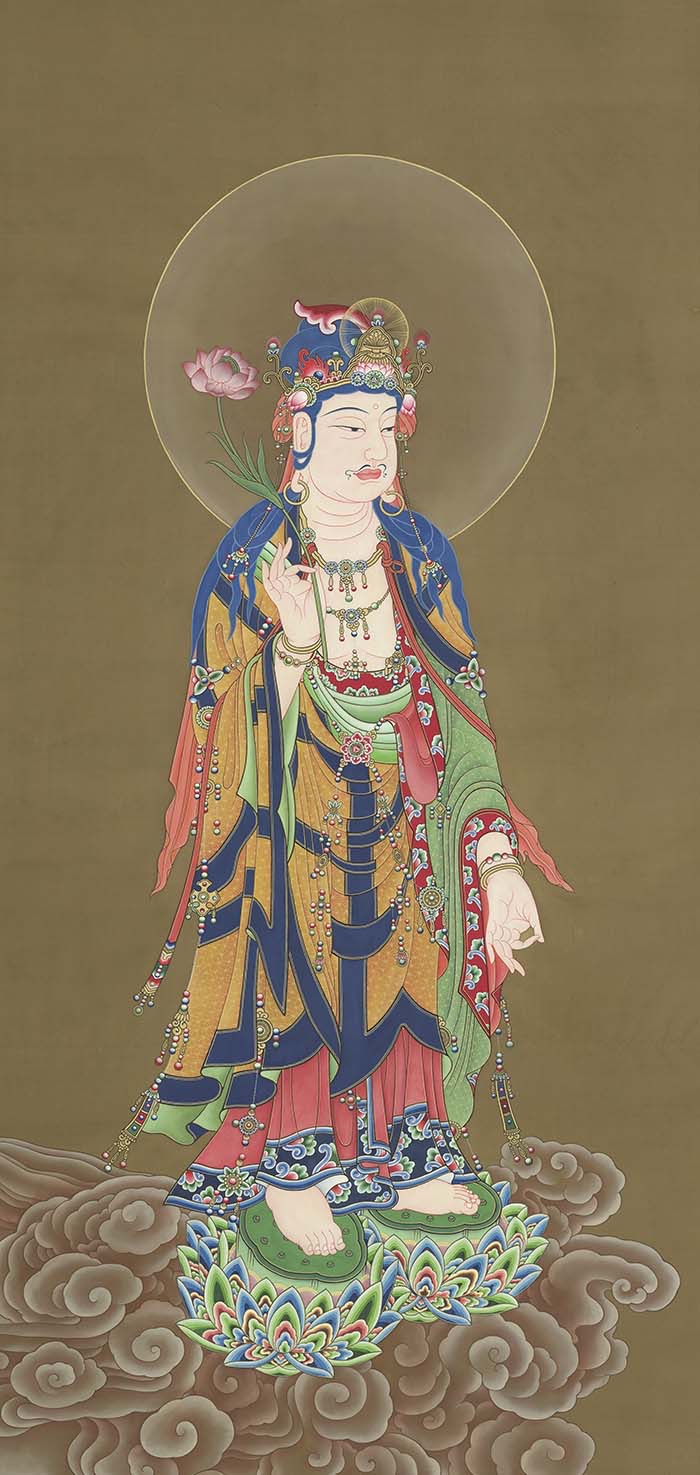
Quick answer: In TK1105, the long flower stem creates a rising diagonal that links the figure’s lowered hand area with a blossom beside the head. That line contrasts with the upright body and halo, giving the composition a clear directional counterpoint. This visual description does not establish the figure’s identity, maker, date, school, or provenance.
What makes a flower stem a compositional line?
A flower stem becomes a compositional line when its direction guides the eye through the image. In TK1105, the stem is not merely a small attribute held by the standing figure: its length and slant make it one of the clearest paths across the otherwise vertical composition. The eye can follow it from the hand upward to the blossom near the head, then return to the face and torso.
This is a description of visible form, not an interpretation of religious meaning. The archive filename associates the image with the “Three Saints of the West,” but the supplied image shows one standing figure. The catalog label may refer to a larger set, a grouping, or another context not visible in this crop. It is therefore safer to retain the title as an uncertain archive label than to treat it as proof of identity or subject.
How to trace the diagonal without guessing its symbolism
Trace the stem as a sequence of visible points rather than assigning a meaning to it. Begin at the hand that holds it, notice where the line changes angle, and follow the shaft to the flower. The blossom sits beside the head rather than directly above the hand. That separation is important: the line connects two different zones of the figure and encourages a small journey through the image.
In a close view, the line can be described in three stages. First, the hand establishes the point of contact. Second, the stem travels upward at a slant, crossing open space beside the figure. Third, the flower creates a compact endpoint close to the head and halo. These observations can be checked against the picture itself. They do not require a claim about what the flower represents, which deity holds it, or what a viewer in another period would have understood.
The stem’s angle is also relational. It is diagonal because the body, legs, and central axis of the halo read as mostly upright. If the same stem appeared against a strongly slanted figure or a tilted ground, its effect might be different. Here, the contrast between upright and oblique directions makes the flower easy to notice without making it the whole subject.
How the diagonal interacts with the figure’s vertical axis
The standing figure supplies the composition’s principal vertical. The torso and long robe descend toward a lotus base, while the halo frames the head above. Against that stable axis, the stem opens a second direction. The figure remains the anchor; the flower-bearing line supplies movement within that anchor.
That contrast helps explain why the object is visually prominent even though it occupies less area than the body. A viewer often notices not only size but also direction, separation, and contrast. The stem stretches through a portion of the field that would otherwise be comparatively quiet. Its endpoint near the head also draws attention back toward the face, making the object and figure function as a connected pair rather than unrelated details.
The head’s turn provides another visible cue, though it should be described cautiously. The face is not presented as a perfectly frontal mask; it angles slightly toward the adjacent flower. That orientation can make the flower and face feel related in the composition. It does not by itself prove that the figure is looking at the flower, nor does it establish a narrative. The image gives enough evidence to describe proximity and direction, but not to reconstruct an event.
Why the lowered hand matters to the reading
The lowered hand balances the raised flower stem by keeping a second hand gesture near the body’s lower half. In the image, one hand participates in holding the stem while the opposite arm falls downward with an open hand. The two sides are not identical: one is linked to a long object extending into open space; the other remains close to the robe and the lower field.
This difference gives the viewer a useful way to compare the figure’s sides. The stem creates an outward and upward reach; the other arm offers a quieter downward counterweight. Together they keep the body from reading as a rigid column. This is a purely compositional account. The gestures may have iconographic meanings in a broader tradition, but identifying those meanings would require reliable subject-specific evidence beyond this image alone.
When describing an image for a catalogue, avoid turning “open hand” into an automatic doctrinal label. Record what is actually visible: which hand is raised, what it appears to hold, where the other hand rests, and how the arms relate to the torso. If a separate source confirms a named gesture, that can be added with attribution. Until then, plain visual language preserves both accuracy and room for later research.
How the base and cloud field keep the figure grounded
The flower’s rising movement is balanced by forms at the bottom of the picture. The figure stands above a lotus-like base amid cloud forms. Those lower shapes create a broad visual foundation beneath the elongated body. They also prevent the composition from being read as a simple isolated silhouette: the figure occupies a space organized from base to halo.
There is a useful contrast between the compact support below and the fine diagonal beside the head. The base spreads the image laterally near the bottom, while the stem narrows into a slender path higher up. The halo then gathers attention around the head. Taken together, these forms offer three different kinds of emphasis: a supporting platform, a directional line, and a circular frame.
These observations should not be confused with a reconstruction of the original painting’s physical setting. The available reproduction cannot establish the material, original dimensions, condition, or full decorative context. It can support a measured description of the visible arrangement. A high-resolution view may clarify contours and color transitions; it still cannot independently verify a collection history or date.
A practical method for describing this kind of image
Use a repeatable sequence so that visual description stays separate from attribution. First, identify the overall format: a single standing figure, a halo, and a lotus-and-cloud base are visible in this image. Second, locate the main axes: the figure is largely vertical, while the stem rises diagonally. Third, describe contact and endpoints: a hand holds the stem, which ends in a blossom near the head. Fourth, note counterbalances, including the lowered open hand and the base. Finally, mark any historical or religious identification as uncertain unless a dependable source confirms it.
This method is useful because it remains informative even when a title is uncertain. It also makes later comparison possible. Another painting can be assessed by asking whether its flower is held upright or angled, whether the blossom sits near the face or farther away, and whether a diagonal balances a vertical figure. The comparison then rests on observable choices rather than assumed symbolism.
For accessibility, alt text should identify the depicted arrangement in concise language rather than repeat an unsupported catalogue claim. The ALT for TK1105 names the standing figure, halo, flower stem, blossom, and base. It does not state a deity, artist, period, or provenance. This distinction helps both screen-reader users and researchers understand what the image itself visibly supports.
Frequently asked questions
What is the main visual feature in TK1105?
The clearest feature is the long stem that rises diagonally from the figure’s hand toward a blossom beside the head. Its direction contrasts with the figure’s mostly vertical posture.
Can the figure be identified from the flower alone?
No. A flower can be an iconographic clue, but this image and filename do not independently verify the figure’s identity. The archive title is retained as uncertain context, not treated as confirmation.
Does the figure look toward the blossom?
The face appears slightly turned toward the adjacent flower, but a reproduction cannot prove a narrative action or intention. “The blossom is near the turned head” is more precise than claiming the figure is looking at it.
Why mention the other hand?
The lowered open hand provides a visible counterpoint to the hand holding the stem. Describing both sides explains how the pose balances outward movement with a quieter line beside the body.
Sources and editorial method
This article is based on direct visual analysis of the TANGKAWORLD reproduction of TK1105. It separates visible evidence—the standing pose, halo, stem, blossom, lowered hand, base, and clouds—from religious identification and historical attribution, which remain uncertain here. The archive wording “Three Saints of the West” is not treated as proof that the pictured crop contains three figures. For a broader account of image study and source practice, see TANGKAWORLD’s thangka iconography study guide.
Prepared and reviewed by the TANGKAWORLD editorial team
Last reviewed: October 7, 2026
Continue exploring TANGKAWORLD: visit the home page, browse Learn, or explore the Download collection.

