How a Profile Face Alters a Frontal View in Buddhist Art: TK0184 (“Avalokiteshvara - Anonymous”)
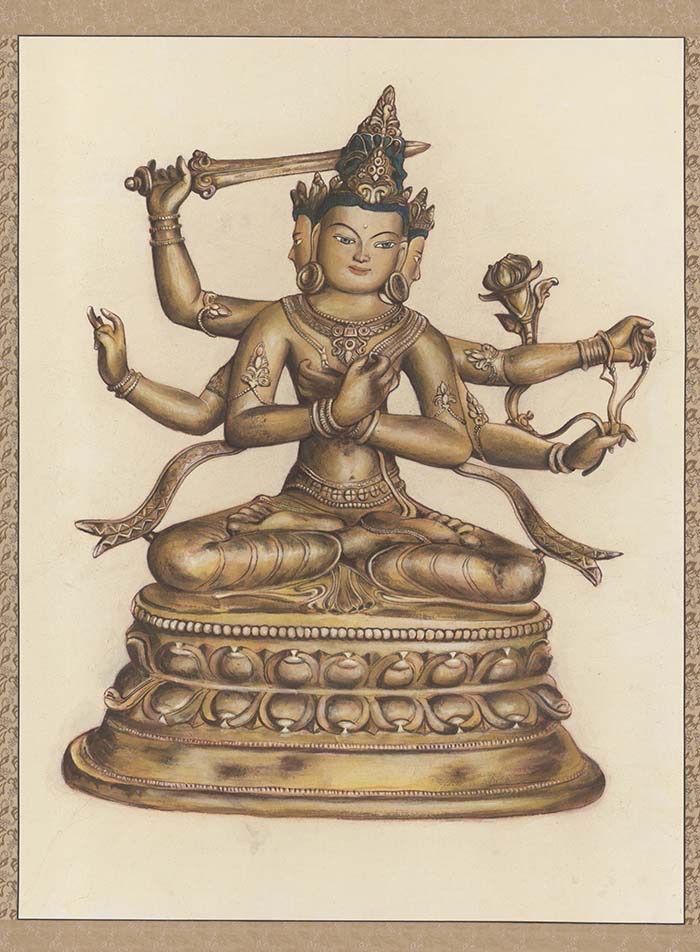
Quick answer: TK0184 places a frontal face beside at least one clear side-facing profile. Record each orientation and visible contour separately instead of inferring a named multi-faced form from a small reproduction. The archive label “Avalokiteshvara - Anonymous” is useful retrieval metadata, but the image alone does not confirm identity, date, maker, or the exact number of represented faces.
What does the image show before we interpret it?
TK0184 presents a seated, richly ornamented figure whose central face looks toward the viewer. At least one profile is visible beside it, facing toward the viewer’s left. The paired views make the head read differently from an ordinary single frontal portrait, but they do not by themselves establish the figure’s name or the doctrinal meaning of the arrangement. Begin with the visible orientation, not with a familiar iconographic label.
The image also contains a high crown, jewelry, several arms, and elongated or flower-like forms near the hands. Those details give context to the head, but they should be recorded separately. A crown edge can sit close to a profile; an earring can create a line that resembles a cheek or jaw; and an arm or ornament can overlap the outer silhouette. The goal is not to decide everything in one glance. It is to make a clear inventory another viewer could check.
A concise first note might read: “Seated crowned figure; central face frontal; one distinct side-facing profile visible at the viewer’s left; additional facial contours uncertain at this reproduction size.” That sentence keeps observation firm while identifying the limits of the image.
How should you describe a profile without guessing?
Describe the direction and contour that can be seen. A profile usually presents the face from the side: the forehead, nose, lips, and chin form an outline rather than a pair of balanced frontal eyes. In TK0184, the side-facing face appears adjacent to the central frontal face. Use “profile” for that visible orientation, and avoid assigning the face a separate identity or role unless additional evidence supports it.
Use a simple sequence when examining the head:
- Locate the central facial plane and note whether it faces the viewer, turns, or is partly obscured.
- Follow the outer head contour beside it; look for a continuous forehead–nose–mouth–chin outline rather than an isolated curve.
- Separate the face from nearby crown points, hair, earrings, jewelry, and background marks.
- Record the direction of each legible face using the image’s left and right, then clarify “viewer’s left” or “viewer’s right.”
- Mark a contour as uncertain if the face-to-head connection or its boundaries are hidden.
This procedure is useful because it does not require the viewer to know the name of the deity. It also limits a common interpretive leap: moving from “I can see a profile” to “I know why this profile is present.” The first is a visual statement; the second may depend on a specific textual, ritual, or collection context that is not visible in this reproduction.
How does the profile change the frontal composition?
The side view interrupts the expectation that the central face is the only viewpoint. The frontal face anchors the figure, while the profile beside it extends the head laterally and introduces a turn. As a result, the viewer reads the head as a layered arrangement rather than as a simple front-facing mask. This is a compositional effect visible in the image, even when the profile’s symbolic meaning is unknown.
The arrangement also changes how the crown is read. A single frontal head is usually perceived as one bounded shape beneath its headpiece. When a profile emerges beside it, the headpiece and facial outlines become a small system of overlapping forms. A viewer can ask which crown elements sit above the frontal face, which appear behind the profile, and where the boundary between face and ornament remains unclear. These are practical visual questions, not conclusions about the age or workshop of the painting.
TK0184’s other features help hold the composition together. The figure’s torso and crossed central arms create a stable vertical center, while lateral arms and stems widen the silhouette. The profile sits within that broader spread. Its position can be described in relation to the frontal face, crown, and shoulders without claiming that the arrangement has a particular narrative meaning.
Does a second contour always prove another face?
No. A dark curve near a face is not enough to count another head. It may belong to a crown ornament, hair, an ear, jewelry, a fold, or a separate facial plane. To treat a contour as a face, look for a coherent set of features—such as a forehead leading into a nose and mouth—and for a plausible connection to the head. If one of those cues is missing, say that the edge is suggestive but uncertain.
It is also important to separate “face” from “head.” A profile can be visible as a facial plane while its full head outline is hidden behind the frontal face or crown. Conversely, an ornamental shape may look like a profile without containing clear facial features. A careful record can say “one profile is clear; another possible contour cannot be confirmed” rather than forcing an exact count.
When comparing images, use consistent criteria. Do not count every curve in one painting but require a complete outline in another. Note whether the forehead, nose, lips, and chin are visible; whether the features face left or right; and whether the face overlaps the central plane. This makes comparisons more useful for research and less dependent on expectation.
How can you separate facial features from surrounding ornament?
Trace the head from the face outward. First follow the forehead and cheek, then the jaw and chin. Next inspect the crown, hair, earrings, and necklaces as separate elements. The order matters because elaborate Buddhist figures can bring face, jewelry, and headwear into close contact. In a reduced image, a decorative line may appear to continue the jaw when it actually belongs to an ornament.
Check for repeated structural cues. A genuine face normally has an internal arrangement of features, while a crown point or jewel usually follows the geometry of the headpiece. Compare the scale and orientation of the suspected profile with the central face. Ask whether its nose, mouth, and chin align in a plausible way, and whether the color or outline continues consistently. If the image does not resolve those questions, preserve the ambiguity rather than sharpening it into a confident identification.
What does the archive title establish?
The source filename calls the image “Avalokiteshvara - Anonymous.” Preserve that English title as an archive label, but do not treat it as independent proof of identity. The visible frontal face and profile can support a description of the composition; they cannot establish the religious figure, a particular manifestation, artist, date, school, original setting, collection, or provenance.
This distinction keeps useful metadata without overstating it. An archive title can guide future searching and comparison, especially when it records a traditional name. A verified inscription, reliable catalog record, or close comparison with documented works could strengthen an identification. Until such evidence is available, write “catalogued as Avalokiteshvara; attribution uncertain” and keep the observed face directions in a separate descriptive field.
The distinction also protects the image from circular reasoning. If a title is first assumed to be correct, the profile might then be interpreted to fit the title; that interpretation could later be cited as proof of the same title. Keeping observation, archive naming, and historical attribution separate makes the record more transparent and easier to revise.
Frequently asked questions
How many faces can be confirmed in TK0184?
The reproduction clearly presents a frontal face and at least one side-facing profile. The exact total is uncertain because some contours near the headpiece are difficult to separate from overlapping forms at this image size.
Does the profile identify the figure as Avalokiteshvara?
No. The filename supplies that archive label, but a profile beside a frontal face is not sufficient on its own to establish a deity or a specific form.
Is the side-facing profile looking in a particular direction?
Its visible facial orientation faces toward the viewer’s left. That describes the profile’s direction in the image; it does not establish the figure’s narrative gaze, ritual function, or intended viewer.
How should an uncertain facial outline be recorded?
Describe the visible contour and its location, then state what prevents confirmation—for example, overlap with the crown or unclear facial features. Avoid counting it as another face until the evidence is legible.
Sources and editorial method
This article is based on direct visual analysis of the TANGKAWORLD TK0184 reproduction. It distinguishes visible evidence—the central frontal face and side-facing profile—from the archive’s proposed identification and from historical claims the image cannot establish. The exact face count, deity, manifestation, date, maker, school, collection, and provenance remain uncertain. For a broader evidence-first framework, see TANGKAWORLD’s guide to what a thangka is and how to read one and its visual guide to separating head adornment from nearby forms.
Prepared and reviewed by the TANGKAWORLD editorial team
Last reviewed: October 23, 2026
Explore further: Visit the TANGKAWORLD home page, browse the Learn guides, or get the image collection from Download.

