How to Cite a Detail Crop in Buddhist Art: Reproducible Notes from TK0271
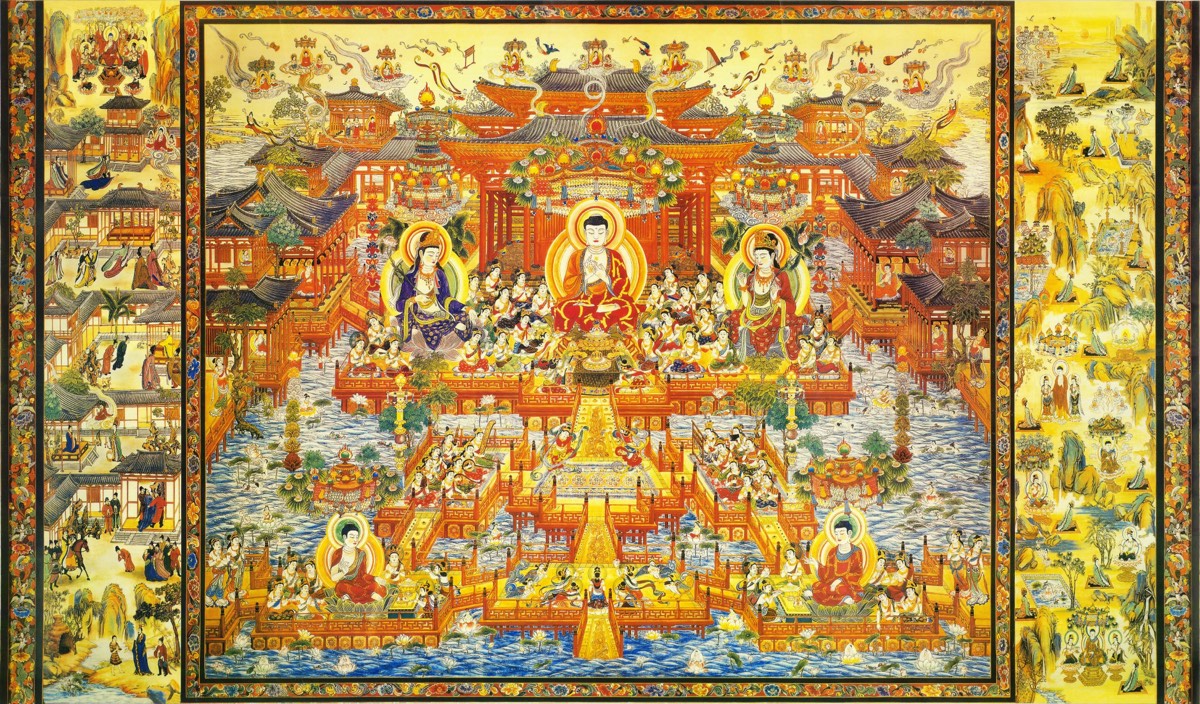
Quick answer: A useful detail crop needs a stable parent-image citation, a named region, coordinates or clear boundaries, and a note about the file version. For TK0271, distinguish the central palace-and-pond field from the two narrow side panels, then cite each crop back to the complete Western Pure Land image.
A close-up makes a dense Buddhist painting easier to discuss, but an uncited crop can conceal a panel border, nearby figure, or relation to the larger scene. TK0271 is a useful case: its broad central field is flanked by two narrow illustrated panels, all held within visible ornamental borders. This guide asks how to reference details so another reader can find the same place in the same image.
The archive title is Western Pure Land. The visible image supports a broad Pure Land reading: a central Buddha-like figure is flanked by haloed attendants, with palace buildings, a gathering, water, and lotus forms. Specific figures, episodes, architectural names, date, and provenance are not confirmed by the pixels or filename alone.
What information makes a crop reference reproducible?
A reproducible reference identifies the source image, region, crop boundary, and file version. “See the temple” is insufficient when the image contains several pavilions and “temple” may itself be an interpretation. Separate the locator from the interpretation: first identify where a detail appears, then explain what it may represent.
Record the archive title and TK number; the version used (full archive image or public derivative); a neutral region label; the boundary as normalized coordinates or a panel edge; and the viewing date and any image adjustments. These fields make a crop findable without turning it into a new object record.
How should TK0271 be divided before zooming?
Start with the complete image and mark its large structural regions before selecting details. TK0271 has a central rectangular composition and narrower vertical scenes on the left and right. Ornamental borders separate them. This visible division is a more reliable starting map than guessing the story in a small scene.
| Region ID | Neutral description | Context to retain |
|---|---|---|
| 0271-C | Central framed palace-and-pond field | A border edge and nearby figure or water |
| 0271-L | Left narrow illustrated panel | Panel boundary and adjacent ornament |
| 0271-R | Right narrow illustrated panel | Panel boundary and adjacent ornament |
These IDs are locators, not traditional names or iconographic conclusions. The side panels contain small figures, buildings, and landscape details, but their episodes remain uncertain unless inscriptions or reliable comparison identify them.
Which coordinate system should an archive use?
Use normalized coordinates when a crop must remain locatable after resizing. Let the source width be W and height H. For a rectangle with upper-left corner (x₁, y₁) and lower-right corner (x₂, y₂), record each coordinate as a fraction of the matching dimension: x/W and y/H. The resulting left, top, right, and bottom values can be written between 0 and 1 or as percentages.
Normalized coordinates are portable, not inherently more precise. Pixel measurements only make sense when paired with exact source dimensions and version. If using percentages, state the upper-left origin and that values refer to the uncropped image. Avoid rounding so much that a small feature falls outside the saved area.
How do file versions affect the reference?
Image derivatives can change both dimensions and detail. The local archive source for TK0271 is 7500 × 4399 pixels; the existing public media image is 1200 × 704. Pixel coordinates from one cannot be applied to the other. Broad panel boundaries remain useful descriptive locators, but fine line details require the highest-quality available source.
Record whether a derivative was resized, sharpened, color-adjusted, or compressed, and never overwrite the original. Tie each crop filename or caption to the TK number and region ID so a reader can return from “0271-R” to the complete painting.
How can a small feature be described without overclaiming?
Describe what can be seen before assigning a function or identity. “Small figure beside a tiled roof” is an observation; “Amitabha welcomes a named disciple into a specific palace” is a stronger claim requiring iconographic, textual, or documentary evidence. A two-field note helps keep them apart:
- Visible evidence: shape, color, position, orientation, number of figures, building form, border, and relations to nearby details.
- Interpretation: possible identity, episode, ritual function, date, workshop, or historical setting, each with a confidence level.
If the crop cannot resolve a hand-held object, say so. If the full image shows that a mark belongs to the border, update the record while retaining the earlier note as superseded. Transparent revision is better than false certainty.
What should a shared crop caption say?
A caption should help readers locate the detail and understand the claim’s limits. For example: “TK0271, region 0271-R (right side panel), public 1200 × 704 derivative; boundary recorded relative to the full image; viewed October 2, 2026. Episode identification uncertain.” Pair the crop with a small full-image locator when possible; keep the crop boundary separately so it can be regenerated if the master changes.
A repeatable detail-citation workflow
Use the same sequence for every dense painting:
- Record the title, TK number, dimensions, and image version.
- Mark major composition zones before zooming; keep borders visible.
- Assign neutral region IDs such as 0271-C, 0271-L, and 0271-R.
- Record crop boundaries relative to the original dimensions and state the coordinate origin.
- Write literal observation first; put religious or narrative interpretation in a separate field.
- Keep the source untouched and create any display crop as a derivative.
- Include region ID, version, and uncertainty in captions and references.
Why keep the whole image attached to every detail?
The complete image preserves relationships a close-up cannot show. In TK0271, the central palace, assembly, lotus water, side panels, and outer border establish a spatial order. A detached crop can remove the boundary that distinguishes a central gathering from a separate register. Returning to the whole also discourages treating a stylized building as a documentary view of a real historical site.
Frequently asked questions
Why use TK0271-C, TK0271-L, and TK0271-R?
They are neutral working identifiers for the central field and two side panels. They help readers locate a crop without asserting what an uncertain scene depicts.
Are normalized coordinates better than pixel coordinates?
They transfer more easily across resized versions, but the source version and coordinate origin must still be stated. Pixel coordinates are useful when paired with exact dimensions.
Can a crop identify the small figures in the side panels?
A crop may reveal details, but identity usually requires more than appearance. Keep the description literal and mark names or episode readings uncertain until stronger evidence is available.
Should the public web image replace the local archive master?
No. A public derivative can support viewing, but it should remain distinct from the untouched source. Record the version cited and preserve the master unchanged.
Conclusion
A detail crop is strongest when traceable to its parent image. TK0271 can be mapped through a central field and two side panels, but those locators are useful only when a citation also records the version, boundary, and level of interpretation. This lets readers compare details without turning fragments into unsupported object histories.
Sources and editorial method
This article is based on direct visual analysis of the TANGKAWORLD archive image Western Pure Land, TK0271. It separates visible layout and file dimensions from religious interpretation and uncertain episode identities, maker, date, school, collection, and provenance. For broader high-resolution viewing practices, see How to Study Thangka Iconography with High-Resolution Images and the TANGKAWORLD Learn center.
Prepared and reviewed by the TANGKAWORLD editorial team. Last reviewed: October 2, 2026.

