How to Write Alt Text for Buddhist Art: A Visual Description of TK1111
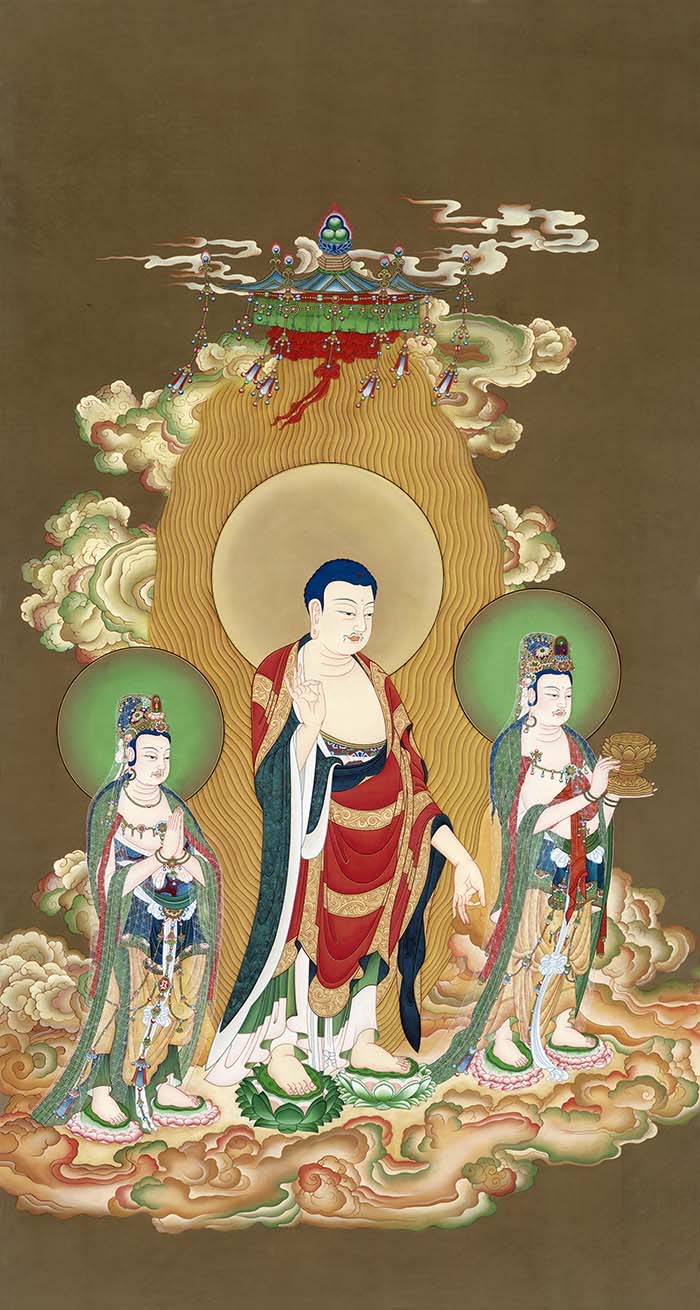
Quick answer: Good alt text for Buddhist art names the main visible subject, its important arrangement, and one or two distinguishing details without guessing identities or history. For TK1111, describe three haloed standing figures, a larger central figure, lotus bases, clouds, and a jeweled canopy; keep uncertain names in the caption or research notes.
What should alt text do for a Buddhist painting?
Alt text should give a concise verbal substitute for the image’s essential visual information. It helps a reader who cannot see the picture understand what is present and how the composition is organized. It is not a full catalogue record, theological interpretation, or place to repeat every keyword associated with Buddhism.
For a complex devotional painting, prioritize the central subject and the relationships that make the image legible. A useful description usually answers three questions: What kind of visual subject is shown? What is the main figure doing or how is it positioned? Which surrounding details materially distinguish this image from another? Begin with the whole scene, then add selected particulars.
TK1111 is a good test because several visually prominent elements share a narrow vertical field. Three haloed figures stand on lotus bases amid layered clouds. The central figure is larger and raises one hand; two crowned companions flank it, and a jewel-like canopy sits above. An alt description can communicate this structure without assigning names that the image alone cannot establish.
Separate what is visible from what is inferred
Describe visible evidence directly and reserve interpretation for text that can carry qualifications. In this image, “three haloed standing figures” is a visual description. Calling the central figure Amitabha and the companions Avalokiteshvara and Mahasthamaprapta would be an iconographic identification. The archive folder’s title “Three Saints of the West” suggests such a reading, but a filename is not independent proof. That identification remains uncertain.
This distinction matters in Buddhist art, where similar postures, crowns, flowers, hand gestures, and color schemes recur across figures and traditions. A small object may be hard to distinguish at the available resolution. If an attribute is unclear, describe its visible shape cautiously—“a lotus-like object,” for example—rather than converting resemblance into certainty.
Alt text should not become a miniature attribution essay. Dates, schools, workshops, collection history, provenance, ritual lineage, and textual interpretation require evidence beyond a single image. If those questions matter to the reader, explain them in the article or caption and identify their uncertainty. Keep the image description focused on the visual scene.
Build a description from the largest visual relationship
Start with the compositional fact a reader would miss without the image. For TK1111, that is not merely “a Buddhist painting.” It is a three-figure arrangement with a larger central figure and two flanking figures. This relationship gives a useful mental map before the description adds surface details.
Then add only details that help distinguish the image: the figures are standing, each has a halo, they stand on lotus bases, clouds surround the lower field, and a decorative canopy appears overhead. Exact robe shades, every pendant, or a count of cloud curls are visible, but they do not all belong in a compact alternative description.
Use an editing test: remove each phrase in turn. If removing it makes the scene materially harder to picture or distinguish, keep it. If it merely inventories decoration, move it to a caption or longer description. The goal is informative selection, not maximal length.
Use a repeatable five-step workflow
A repeatable workflow makes descriptions more accurate across a large image archive. Apply the same sequence before writing, and record uncertain readings instead of silently resolving them.
- Confirm the image and its use. Check that the selected file is the intended full composition, not a crop or thumbnail. Ask whether it is informative content, a link, or decoration. A decorative image may need empty alt text in some contexts; an artwork shown for study needs useful description.
- Read the whole composition first. Identify the main subject, its position, and the arrangement around it. Do not begin by naming a small emblem or repeating the file title. For TK1111, the whole-image structure is a central figure with two companions beneath a canopy.
- Choose two or three distinguishing visual facts. Prefer action, placement, posture, and meaningful objects over a long color list. Here, “standing,” “raises one hand,” “lotus bases,” and “layered clouds” communicate more than a sequence of robe colors.
- Check every identity claim. Ask whether a name is supported by visible attributes and a reliable record, or merely suggested by a folder label. If uncertain, use a neutral description. Do not present an archive label as a verified museum title.
- Read the sentence aloud and shorten it. Keep one clear sentence where possible. Remove repetitions such as “image,” “picture,” and “painting,” and avoid “image of.” The surrounding page already establishes that the reader is looking at an illustration.
These steps are not a rigid formula. A close-up of an inscription may need its legible text; a teaching diagram may need its labels and relationships; a decorative divider may not need a descriptive sentence. The intended use controls what is essential.
A model alt description for TK1111
A concise option for this full image is: “Three haloed Buddhist figures stand on lotus bases above layered clouds; the larger central figure raises one hand beneath a jeweled canopy — TK1111.” This sentence describes arrangement, action, and two visual details. It avoids naming the figures, dating the work, or repeating the uncertain archive title.
The wording can change with context. If a page already introduces the image as TK1111, the identifier may be unnecessary in the alt attribute and can instead appear in the adjacent caption. If the image links to a separate page, the accessible link purpose may need to be expressed as well. If a longer caption already explains the composition, a shorter alt may avoid repetition. There is no single sentence that fits every placement.
| Visible evidence | Useful wording | Keep out unless verified |
|---|---|---|
| Three standing figures, one larger | “three haloed figures, with a larger central figure” | Specific deity names inferred only from the folder |
| Raised hand and a held object | “raises one hand”; “holds a lotus-like object” if needed | A ritual meaning or mudra name not established |
| Clouds, lotus bases, overhead canopy | Name only details that clarify the scene | Unverified period, school, maker, collection, or provenance |
Alt text, captions, and research notes have different jobs
Alt text gives a concise description where the image appears. A caption can provide the archive identifier, a cautious title, and context for sighted readers. A longer article can explain why an identification is uncertain and what evidence would be needed to improve it. Keeping these functions distinct prevents the alt attribute from becoming a crowded metadata field.
For example, a caption might say that the work is archived under the title “Three Saints of the West,” while noting that the label has not been independently verified. A research note can compare visible gestures and held objects with documented examples. The alt can remain neutral and readable. Readers then receive immediate visual access and a transparent account of interpretation.
Do not treat alt text as an SEO keyword slot. Repeatedly inserting phrases such as “Buddhist painting,” “Buddhist art,” and “thangka image” makes the sentence less natural without making the visual information clearer. One accurate subject phrase, followed by concrete visible details, is usually more useful than a list of search terms.
Frequently asked questions
Should alt text identify the Buddha or bodhisattvas?
Only when identity is supported by reliable evidence. If identification is uncertain, describe visible features and put the qualified interpretation in a caption or article instead.
Should every color and ornament be included?
No. Choose a few details that help a reader understand the composition or distinguish the work. A full inventory belongs in a longer visual description or research note.
Is the filename a reliable source for the artwork’s title?
Not by itself. A filename can preserve an archive label, but it does not prove the title, maker, date, school, collection, or provenance. Treat those claims as uncertain until independently supported.
Should the TK number appear in the alt text?
Use it when the identifier helps distinguish the image in an archive or is needed to understand a linked destination. If the adjacent caption already names it, repeating it in alt may add little.
Sources and editorial method
This article is based on direct visual examination of TANGKAWORLD image TK1111. Visible evidence includes three haloed standing figures, lotus bases, clouds, a raised hand, and an overhead canopy. Religious identities are interpretations, not all visible facts; the archive title is unverified, and maker, date, school, collection, and provenance are uncertain. For a broader observation method, see How to Study Thangka Iconography with High-Resolution Images, including its Sources and further reading. More guides are available in Learn.
Prepared and reviewed by the TANGKAWORLD editorial team
Last reviewed: October 5, 2026
Explore TANGKAWORLD: visit the home page, browse Learn, or see the image collection and download options.

