How Unequal Arms Shape a Seated Figure in Thangka Art: TK0182
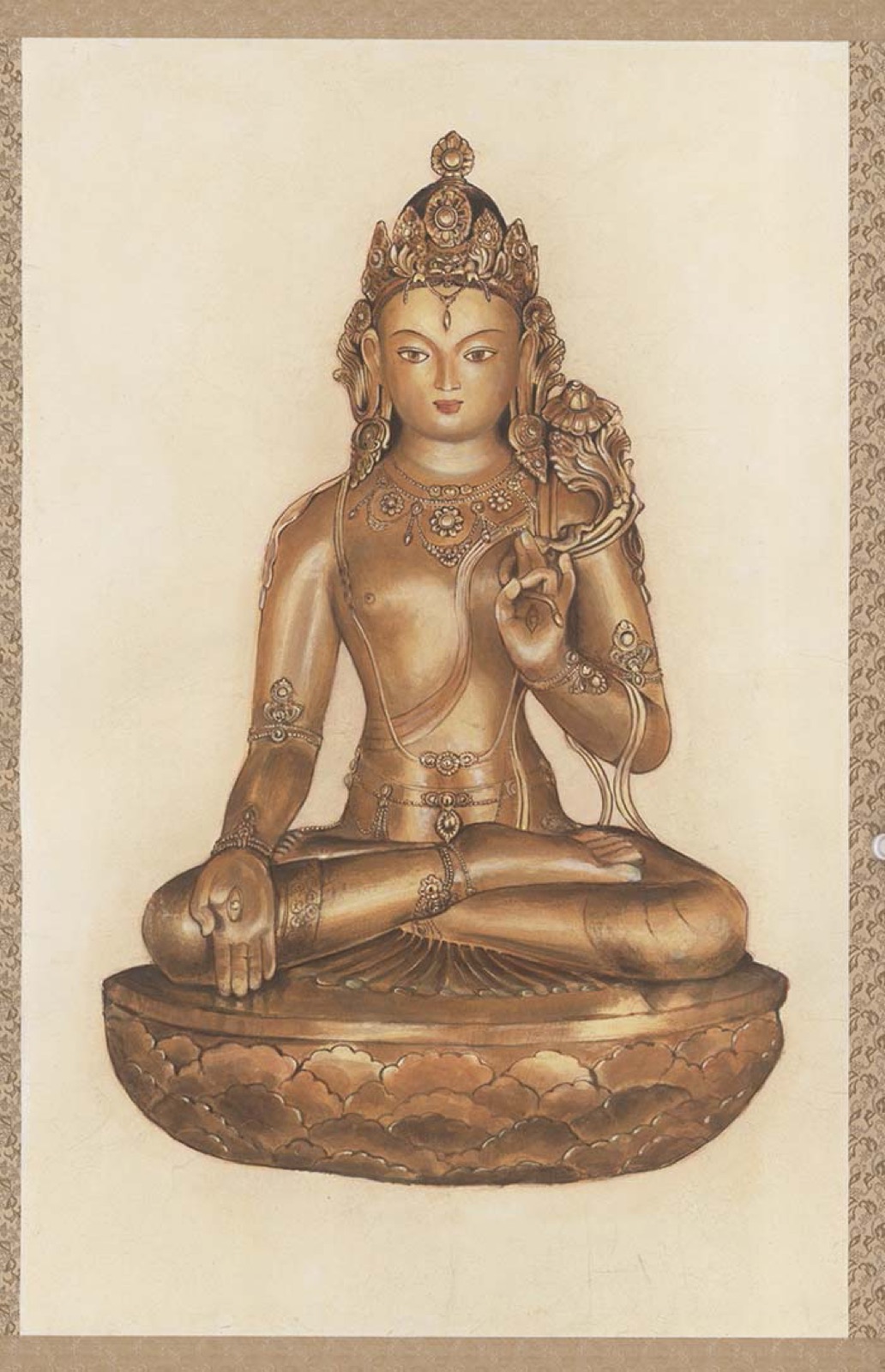
Quick answer: TK0182 shows a frontal, seated bodhisattva-like figure with one forearm lowered toward the knee and the other raised beside a small flower-like form. Describing those unequal arm positions records visible composition without prematurely naming a mudra, an object, or a confirmed deity. The imbalance also creates a gentle diagonal that enlivens the otherwise centered figure.
When a sacred figure is centered and nearly frontal, the viewer may first notice the axis through face, chest, and seat. TK0182 complicates that symmetry: one arm descends toward the bent knee while the other rises beside a small flower-like form. The unequal paths add movement without turning the image into a narrative. Describe this difference before assigning a mudra or deity name.
What is visibly different about the two arms?
The two arms occupy different heights and follow different contours. On the viewer’s left, an arm bends upward from the shoulder, with the hand positioned near the upper torso and a small floral-looking form near the shoulder. On the viewer’s right, the arm descends across the body toward the knee; the hand appears open or relaxed. The exact object and finger configuration are not clear enough in this reproduction to identify confidently.
Use viewer-left and viewer-right rather than the figure’s own sides. This convention makes the note reproducible if a later catalogue mirrors or rearranges the photograph. Record the raised hand, lowered hand, shoulder, chest, knee, and nearby form as visible landmarks; ritual meaning remains a separate interpretation.
How can unequal arms animate a centered figure?
Unequal arms create a controlled diagonal across an otherwise stable, upright body. The eye can travel from the raised hand near the shoulder down across the chest toward the lowered hand and knee. That path interrupts strict bilateral balance, while the face, torso, and seated posture continue to anchor the center.
The raised forearm approaches the flower-like shape, making the upper side more active; the lower arm returns attention to the lap and lotus seat. This describes the visible effect, not the artist’s intention. Trace where each contour begins, turns, overlaps, and stops. If a line is too faint to follow, record that limit rather than completing it from expectation.
How should a viewer describe the raised-hand area?
Describe the raised-hand area by separating the hand, its direction, and the neighboring form. In this image, the hand is elevated near the chest or shoulder, and a slender, plant-like shape appears nearby. The image suggests a flower or stem, but the available view does not establish its species, whether the hand grasps it, or whether the form is a separate attribute rather than part of the ornament.
Small objects are easy to overread. A pale shape may merge with a finger, jewelry, robe edge, or ground, and compression can hide the connection. Record “raised hand beside a small flower-like form; contact uncertain.” Keep any close crop beside the full image so context is not lost.
Why does the lowered hand matter?
The lowered hand provides a counterweight to the raised one. It occupies the lower half of the body and directs attention toward the knee rather than toward the shoulder. In the reproduction, the hand appears to rest over or just in front of the bent leg; the exact contact point is uncertain. That distinction is important: a hand touching a knee, hovering above it, and holding an object are three different observations.
Record the lowered hand’s height, palm orientation if visible, finger shape, and distance from the robe or knee. Do not name a mudra from broad resemblance alone; a formal gesture depends on a defined hand configuration and context. Here, a spatial description is the safer conclusion. The TANGKAWORLD guide to reading a thangka offers a broader sequence for observing posture, attributes, and surrounding composition before settling on an identification.
What keeps the composition from feeling unbalanced?
The figure remains visually stable because several features counter the arms’ unequal directions. The face sits near the vertical centerline; the torso is presented frontally; the crown and necklaces build a dense central mass; and the crossed seated posture rests on a broad oval lotus pedestal. The pale ground around the body leaves the silhouette legible. These elements do not erase asymmetry; they contain it within a larger centered structure.
Color and ornament distribute attention too. Warm gold concentrates on the body, jewelry repeats small marks around the chest, and the pedestal supplies a horizontal base. The diagonal arm is balanced by the frontal torso and seat. Reduce the image to head, torso, arms, legs, and base: if it still reads centered, broad masses—not mirror symmetry—create stability.
How to document the arm arrangement without guessing
A repeatable note should move from location to shape and only then to interpretation. Use the following sequence for TK0182 or another single-figure painting:
- Fix orientation. State that left and right refer to the viewer, and record the image identifier and source filename.
- Map each arm separately. Start at the shoulder, follow the visible upper arm and forearm, and finish at the hand. Mark any obscured section.
- Describe the hand. Note height, palm direction, finger visibility, and whether it touches, holds, or merely approaches another form.
- Record nearby forms. Use neutral terms such as “flower-like,” “stem-like,” or “small object”; add “uncertain” where the image does not resolve the detail.
- Compare the pair. Note differences in height, direction, distance from the body, and relation to the knee, chest, or shoulder.
- Interpret last. Propose a mudra or attribute only when the hand configuration and the wider iconographic context support it.
This order makes the record useful even if a later researcher revises the deity identification. It also makes disagreement specific: readers can compare the recorded hand position rather than arguing over an unsupported label. The visual guide to lotus stems in Buddhist painting is a relevant comparison for plant-like forms, but it should not be used to force the uncertain shape in TK0182 into a confirmed lotus.
Does the filename prove the figure is Avalokiteshvara?
No. “Avalokiteshvara, Anonymous” is the English archive filename, and it should be preserved as the supplied title, but a filename is not a verified museum record or proof of provenance. The crown, jewelry, seated posture, and flower-like form may be compatible with a bodhisattva reading; none alone settles the identity. The figure should therefore be described as a crowned bodhisattva-like figure, with Avalokiteshvara recorded as an uncertain archive association.
The same caution applies to maker, date, school, collection, and origin. “Anonymous” in the filename only means the supplied title names no artist; it does not establish historical anonymity. Keep visible evidence, archive wording, and unresolved claims in separate fields.
Frequently asked questions
Can the raised hand in TK0182 be assigned a mudra?
Not securely from this view. Its height and direction are visible, but the exact finger configuration and relationship to the small neighboring form are not sufficiently clear to name a mudra with confidence.
Is the small shape beside the raised hand definitely a lotus?
No. It looks flower-like or plant-like, but the image does not resolve enough detail to confirm a lotus, a stem, or the way the hand relates to it.
Why use viewer-left and viewer-right?
Those terms make a description reproducible across readers. They avoid confusion about the figure’s own left and right and make it easier to compare the same side in a photograph or catalogue.
Does an asymmetrical pose mean the image is off-center?
No. TK0182 has unequal arm directions, but its frontal torso, centered face, and seated base still create a strong central organization. Local asymmetry and overall balance can coexist.
Is Avalokiteshvara a confirmed identification here?
No. It is the archive filename’s subject label. The article preserves that title while marking the identity uncertain because the visible image alone is not a complete historical record.
Sources and editorial method
This article is based on direct visual analysis of TANGKAWORLD image TK0182. It records visible posture, arm direction, hand placement, nearby flower-like form, jewelry, seated silhouette, and oval lotus pedestal separately from religious identification. “Avalokiteshvara” is retained only as the archive filename’s uncertain association; the object, mudra, maker, date, school, collection, and provenance have not been independently confirmed. For broader visual-reading methods, see the TANGKAWORLD thangka reading guide and the Learn center.
Prepared and reviewed by the TANGKAWORLD editorial team.
Last reviewed: October 21, 2026.
Conclusion
TK0182 demonstrates how unequal arm directions can enliven a centered seated figure without making its identity or ritual meaning certain. The raised hand and lowered hand create a diagonal; the frontal body, face, ornaments, and broad seat restore visual stability. Recording these relationships first lets the image remain legible while leaving uncertain claims open to better evidence.

