Why Do Paired Attendants Make Different Gestures? TK1112
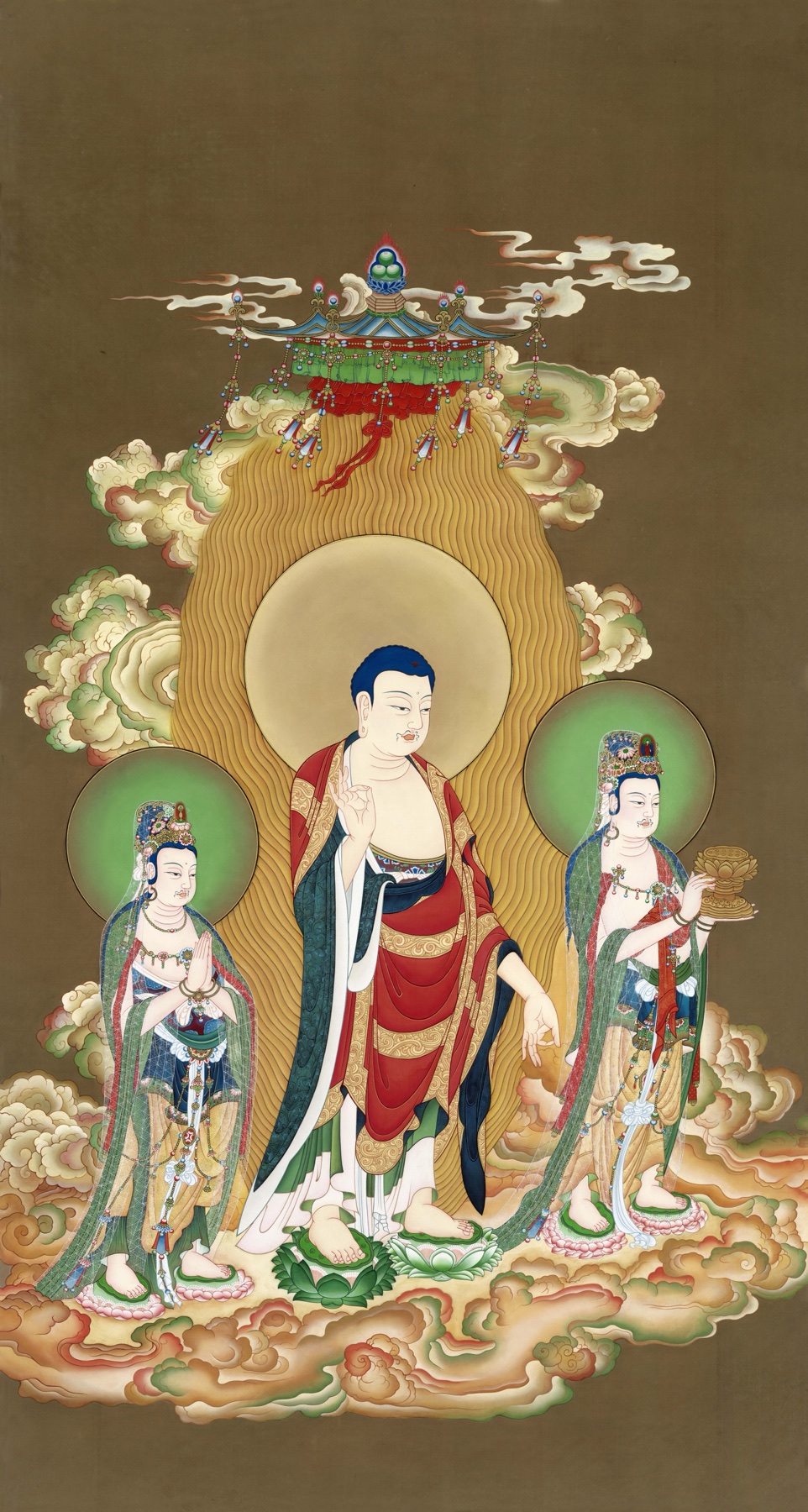
Quick answer: In TK1112, the flanking figures are visually paired but not identical: the left figure presses palms together, while the right presents a lotus-like object; both stand below the larger central figure. This contrast supports a careful comparison of visible roles, but it cannot by itself confirm names, ritual meanings, or the painting’s history.
What can paired attendant gestures tell us in TK1112?
The two side figures in TK1112 share a position in the composition but make different visible gestures. The left attendant holds both hands together in front of the body. The right attendant extends one hand toward a flower-like object supported beside the figure. Their comparable scale, standing posture, halos, crowns, and placement make them a pair for visual analysis; the different hand-and-object relationships keep them from being interchangeable.
That distinction is useful even when names remain uncertain. A viewer can record where each figure stands, what each hand appears to do, and how each relates to the larger central figure before proposing an iconographic reading. The image supports those observations. It does not, on its own, prove that the left figure represents one named bodhisattva and the right another, nor does it establish a ritual meaning for either gesture.
How should you compare the two figures?
Compare them through the same small set of questions rather than letting one striking attribute determine the reading. A consistent method makes similarities and differences visible while keeping interpretation separate from description.
- Start with the whole field. Note three standing figures, a larger central figure, surrounding clouds, separate halos, lotus-like bases, and a canopy above. This establishes the basic hierarchy before attention moves to the attendants.
- Locate each attendant. Record left or right from the viewer’s perspective. Do not switch to the depicted figure’s left or right without saying so.
- Describe the hands. The left attendant’s palms appear joined at chest level. The right attendant’s arm reaches toward an object. State the visible configuration first; do not immediately assign a mudra name or devotional function.
- Describe contact with the object. The right-side object appears flower-like, with a layered or petal-shaped form. Because this is a reduced digital view, “lotus-like” is safer than a definitive identification. The left attendant’s hands meet each other rather than an object.
- Compare position and scale. Both companions flank the central figure and have their own halos. Their similar placement supports comparison, but the central figure’s larger scale remains the strongest hierarchy cue.
- Mark the inference boundary. Keep the visible description in one column and any proposed identification or symbolism in another. If no independent catalogue or inscription is available, label that interpretation uncertain.
This sequence avoids a common shortcut: seeing a flower and naming a deity immediately. Flowers, crowns, hand positions, and colors can recur across Buddhist images. Their value comes from how several features work together, not from treating one motif as a complete identification key.
What is shared, and what is different?
TK1112 combines formal pairing with asymmetry. The attendants occupy corresponding positions, stand at comparable height, and each has a halo and elaborate dress. These repeated features visually connect them. Their hand positions differ: one figure joins the palms, while the other engages with an object. The image therefore offers both a stable comparison frame and a specific difference to investigate.
| Feature | Viewer-left figure | Viewer-right figure | What can safely be said |
|---|---|---|---|
| Placement | Beside the central figure | Beside the central figure | The figures flank a larger center |
| Hands | Palms appear joined | One hand reaches toward an object | The visible gestures are not identical |
| Object relation | No separate object is clearly engaged | A flower-like object is presented | Describe it as lotus-like if uncertainty matters |
| Identity and meaning | Not established by the gesture alone | Not established by the object alone | Names and symbolic readings need corroboration |
This table does not claim that a gesture has one universal meaning. It is a record of what is visible in this image, not a key that decodes all paired figures. Another painting may repeat a joined-palms pose while assigning a different role, and an object that looks like a lotus may be represented in a stylized or ambiguous way. Comparison should preserve that flexibility.
Why does asymmetry matter in a balanced composition?
Visual balance does not require identical action. In TK1112, the central figure anchors the vertical axis; the flanking figures provide a left-right frame. Their similar standing scale and decorative treatment make the composition feel coordinated, while the contrast between joined hands and an object-bearing gesture introduces variation. This is a description of visual organization, not proof of a specific doctrinal pairing.
For close looking, the asymmetry creates a practical prompt: compare the attendants with each other before comparing either one with a named iconographic type. Ask whether the same visual feature appears on both sides, whether each figure faces or gestures toward the center, and whether the object changes the contour of one side. These questions can be answered from the image. Questions about the figures’ names, vows, or ritual functions require evidence beyond formal balance.
The distinction also helps prevent over-reading. If the right hand and flower-like form are small or softened in a screen copy, a viewer may be tempted to complete the image from memory. A careful note can preserve the uncertainty: “right attendant reaches toward a lotus-like object; exact attribute unclear.” That sentence remains useful if a better scan later clarifies the form.
What details should a comparison record include?
A useful comparison note is short, repeatable, and explicit about confidence. For this image, record the archive identifier, viewing orientation, the two hand configurations, the flower-like form, and the shared placement beside a larger central figure. Add a confidence marker only to interpretations, not to straightforward observations.
One compact record could read: “TK1112; viewer-left attendant, palms joined at chest; viewer-right attendant, one hand extended toward a lotus-like object; both haloed and standing beside a larger central figure. Archive title and personal identities uncertain.” This is more informative than either a bare label such as “attendants” or a confident name unsupported by a source.
If you later compare another image, retain the same columns: position, posture, hands, object contact, halo, base, relation to the center, and source of identification. “Not visible” and “uncertain” are legitimate entries. They prevent an empty cell from being silently filled by expectation. Keep a note of whether you are studying a full image or a crop, because a detail cut off at the edge may appear different from its role in the complete composition.
When a reliable catalogue, inscription, or specialist source becomes available, add the reference and state precisely which claim it supports. A source that names an object does not necessarily prove a date or workshop; evidence for one field should not be stretched into another. This separation lets a visual observation remain useful even when the historical record is incomplete.
What this comparison cannot establish
The gesture contrast cannot establish the attendants’ identities, the exact object held on the right, a formal mudra name, the intended ritual meaning, or the date and origin of the painting. Nor does the folder title independently verify the subject. These questions may eventually be answerable through inscriptions, a documented collection record, or specialist comparison, but they remain open on the evidence used here.
The distinction between observation and identification is not a refusal to interpret. It is a way to make interpretation testable. A reader can agree that palms are joined or that an object is flower-like while still asking whether the proposed names fit the full set of attributes. The visual record is then clear enough for another person to revisit, correct, or extend.
Frequently asked questions
Are the two attendants making the same gesture?
No. In the available image, the viewer-left figure joins the palms, while the viewer-right figure reaches toward a flower-like object. Their shared placement makes them comparable, but their visible hand actions differ.
Does the flower-like object identify the right figure?
Not by itself. It is a useful observation and a possible iconographic clue, but the exact object and the figure’s identity remain uncertain without corroborating attributes or a reliable record.
Can joined palms be assigned a single meaning here?
The image shows the hands together, but that visible fact does not establish one exclusive ritual or doctrinal meaning. A qualified interpretation would need contextual and documentary support.
Is “Three Saints of the West” a verified title?
It is the archive label associated with TK1112, not an independently verified catalogue title. The identification of the figures, maker, date, school, collection, and provenance remains uncertain.
Sources and editorial method
This article is based on direct visual examination of TANGKAWORLD image TK1112. Visible evidence is separated from religious identification and historical attribution: the paired figures’ positions and hand configurations can be described, while names, exact symbolism, maker, date, school, collection, and provenance are uncertain. The image alone is not treated as a museum record. For a repeatable method of moving from whole composition to details and documenting uncertainty, see How to Study Thangka Iconography with High-Resolution Images, including its Sources and further reading, and the wider Learn guides.
Prepared and reviewed by the TANGKAWORLD editorial team
Last reviewed: October 6, 2026
Explore TANGKAWORLD: visit the home page, browse Learn, or see the image collection and download options.

