Daoist Immortal Painting—Segment 1 Right (TK0679): How to Describe Mottled Areas Without Diagnosing Damage
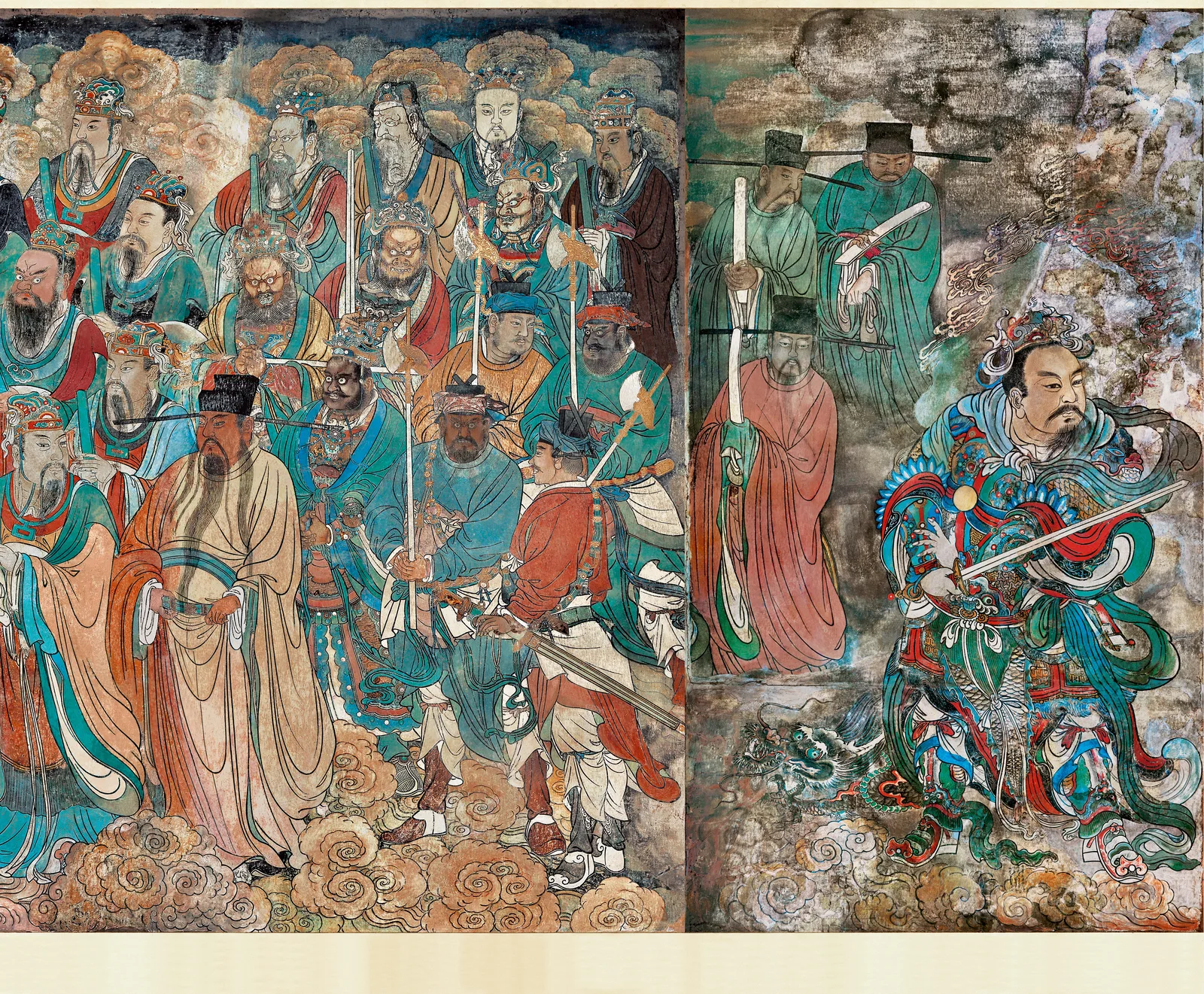
Quick answer: In TK0679, the right side of a large mural reproduction contains mottled pale and dark areas around a smaller group of figures, while the left remains densely populated. These tonal changes can be documented by location and appearance, but a digital image alone cannot establish whether they represent paint loss, abrasion, lighting, retouching, or capture artifacts.
What is visibly different across TK0679?
TK0679 is a wide image with two markedly different visual zones. The left half is crowded with overlapping robed figures, crowns, staffs, and cloud forms. At right, several dark-hatted figures occupy a more open greenish field, beside a larger blue-and-red figure with a long diagonal implement and elaborate cloud-like forms. Above and behind this right-hand group, broad pale, dark, and irregular patches interrupt the more even color around the figures.
That description stays close to what the reproduction shows. It does not identify every person, explain why the two zones differ, or diagnose the physical state of the original wall. The archive folder and filename associate the image with a Daoist-immortal painting and a particular mural context. Those labels are useful for finding the file, but the image itself does not verify its date, location, maker, collection history, or the identities of the figures.
The most responsible starting point is therefore not “the mural is damaged,” but “the reproduction contains mottled areas in the upper and middle right field.” A precise location and neutral description preserve information without turning an appearance into a conservation conclusion.
Why can mottling not be diagnosed from one digital image?
Mottling describes an uneven visual pattern; it does not name its cause. In TK0679, the pale and dark patches vary in shape and contrast. Some appear behind the smaller group, while other irregular areas approach the large figure and surrounding forms. From this file alone, a viewer cannot reliably separate original paint variation from later changes, photographic conditions, image processing, surface texture, or a combination of factors.
A digital reproduction compresses several layers of evidence into one screen image. The camera or scanner records reflected light, not the wall’s material history. Differences in illumination, focus, exposure, color balance, sharpening, stitching, or compression can alter how a surface appears. A high-resolution file may make edges easier to inspect, but resolution by itself does not tell us whether a mark is loss, retouching, staining, plaster, or intentional modeling.
Even a conspicuous contrast is not proof of a specific event. A pale patch might reflect exposed ground, pigment change, glare, a repaired area, or capture conditions. Darkened zones may have several possible explanations as well. Unless an authoritative conservation record or direct examination supports a diagnosis, use “pale patch,” “dark mottling,” “uneven tonal area,” or “detail unclear in this reproduction.”
How should a reader record visible surface clues?
A useful visual note identifies where a feature occurs, what it looks like, how certain the observation is, and what the image cannot establish. For TK0679, divide the reproduction into simple zones: left group, central transition, right group, upper-right field, and lower cloud area. These labels are practical coordinates for discussion, not original architectural divisions.
- Record the reference. Note TK0679, the exact image file or public image URL, the viewing date, and whether you used the full frame or a crop.
- Describe location. Use relative terms such as “upper right behind the dark-hatted figures” or “near the boundary between the crowded group and the open field.”
- Describe appearance only. Record color, shape, boundary, contrast, and whether the feature is sharp or indistinct. Avoid cause words such as “flaking” unless the image clearly shows that physical edge and the evidence supports it.
- Separate observation from inference. Keep a column for what is visible and another for possible explanations. Mark explanations as untested questions, not findings.
- Preserve the comparison image. Save the image version, crop coordinates, display size, and any color or contrast adjustments so a later viewer can reproduce the comparison.
A short entry could read: “TK0679, upper-right field: broad pale and dark mottling behind the smaller standing group; boundaries irregular; cause and relationship to the original surface uncertain.” That sentence says where to look and what is visible without claiming deterioration, restoration, or age.
What details remain readable despite the uneven field?
The reproduction still permits some compositional observations. On the left, many figures overlap; crowns, dark facial outlines, colored robes, and upright objects remain distinguishable in broad form. At right, the smaller figures’ dark hats and pale staffs contrast with their green and red garments. A much larger figure in layered blue and red occupies the lower-right area, where a long diagonal element crosses the body. Clouds and decorative forms fill parts of the bottom edge.
These observations should be calibrated to scale. At a reduced display size, one may recognize a crown or a diagonal line but not reliably read small inscriptions, facial features, or the exact form of a hand-held object. A crisp edge on a web image can also result from sharpening. If the mottled area obscures a contour, write that the contour is indistinct in this reproduction rather than assuming the original painting is incomplete.
It can help to compare the same location at two scales: the full image for spatial context and a close crop for visible edges. Keep the crop tied to the whole image so it does not suggest that a patch is an isolated object or separate panel. Do not enhance contrast and then treat newly visible texture as a confirmed physical feature; label such a view as adjusted.
What should remain uncertain?
Several questions are beyond the evidence available in this reproduction. It cannot independently confirm the archive’s proposed title, the site or hall, historical date, artist, workshop, patron, original installation, conservation history, or provenance. Nor can it establish whether mottling is original surface variation, later intervention, damage, or an effect of image capture. Each claim would require a reliable catalog record, technical documentation, or examination of the original.
The cautious approach is not to avoid interpretation altogether. It is to state the basis for each interpretation. “The right field looks more mottled than the area behind the left group” is a comparison a reader can test. “The right field has suffered water damage” is a causal claim that requires evidence the image does not supply.
FAQ
Does TK0679 prove that the mural is damaged?
No. The image shows uneven pale and dark areas, but it cannot establish their cause or whether they correspond to physical damage on the original surface.
Can the file title confirm the mural’s date or location?
No. The filename preserves an archive label, which is a lead for research rather than independent verification of date, site, maker, or provenance.
What is the safest wording for a visible patch?
Describe its location, color, shape, and visibility—for example, “irregular pale mottling in the upper-right field”—then state that its cause is uncertain.
Should I increase contrast to inspect the surface?
You may compare an adjusted copy as a viewing aid, but record the adjustment and retain the unaltered image. Enhanced contrast is not proof of the original surface’s material condition.
Sources and editorial method
This article is based on direct visual analysis of the TANGKAWORLD reproduction labeled TK0679. Visible groupings, color contrasts, and uneven tonal areas are separated from religious identification and historical attribution. The archive filename is treated as a search label, not as proof of date, maker, location, collection, or provenance. No conservation diagnosis is made from the digital image. For a related evidence-first approach to recording what an image can and cannot show, see the TANGKAWORLD visual condition-report checklist and the Learn library.
Prepared and reviewed by the TANGKAWORLD editorial team
Last reviewed: November 18, 2026
Continue exploring TANGKAWORLD: visit the home page, browse the Learn library, or download the image collection.

