Daoist Immortal Painting—Segment 10 (TK0676): How to Describe the Turquoise Tiered Form Without Guessing Its Function
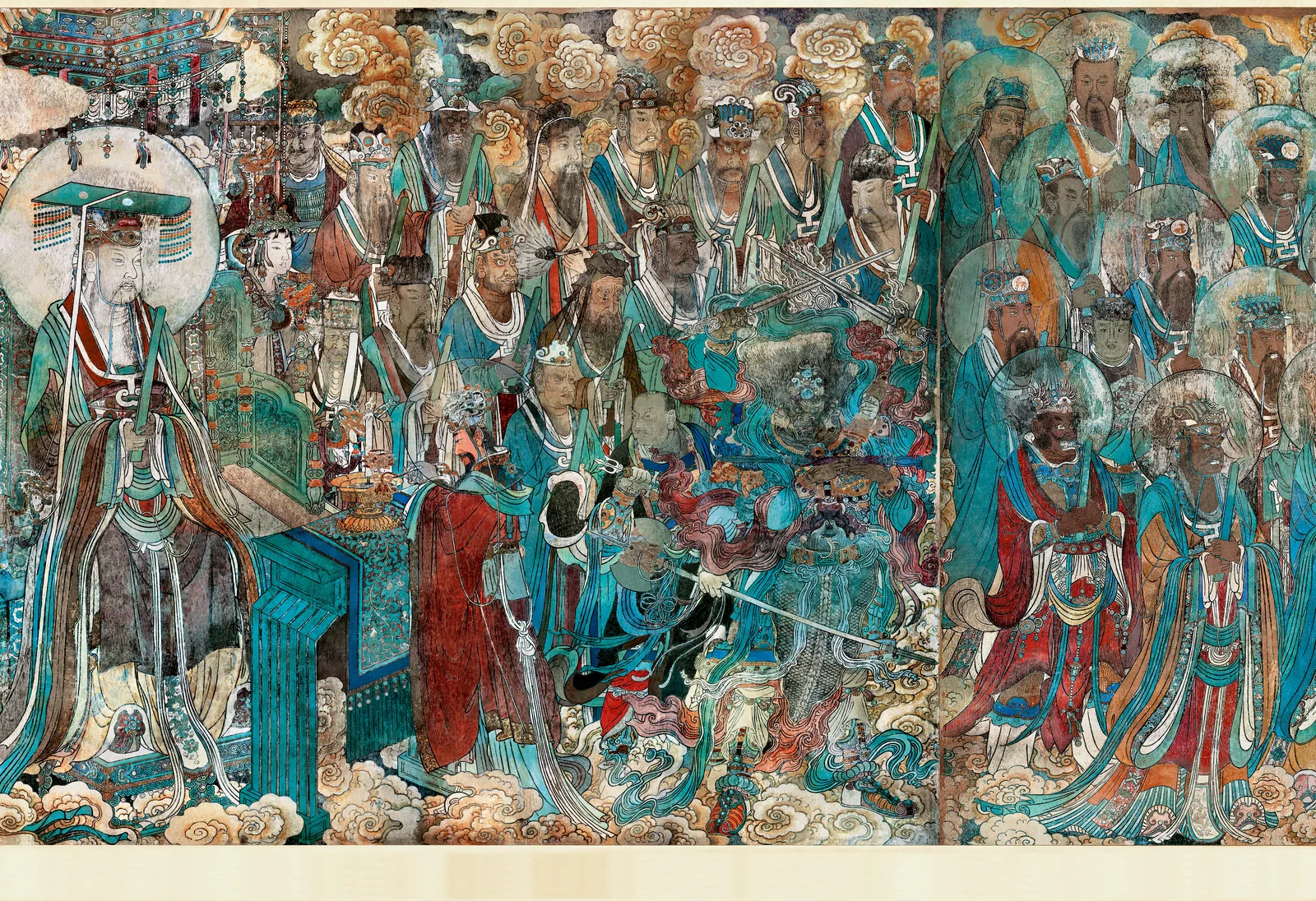
Quick answer: In TK0676, a turquoise, box-like form with stepped planes and patterned panels sits left of center among robed figures. Its crisp geometry contrasts with the curved garments and clouds around it. The image supports a description of shape, color, and placement, but not a confident label such as throne, altar, table, or architectural fitting.
What is visibly present in TK0676?
TK0676 is a wide image crowded with overlapping figures, clouds, and decorative forms. Left of center, a turquoise structure has a broad horizontal top and several rectangular planes below it. Dark outlines divide the front into decorated panels, and the lower part appears stepped or tiered. Robed figures and long implements overlap its edges, making some boundaries difficult to follow. The form is visually prominent, but its exact function is not evident from this reproduction alone.
Color and geometry make the structure easy to locate. Teal and blue-green surfaces stand out against nearby red, cream, and dark robes. Straight horizontal and vertical edges contrast with curling clouds, hanging textiles, and the many rounded contours of the figures. These are observable relationships. Calling the form a throne, altar, table, chest, platform, or architectural fitting would add a functional interpretation that the image does not independently confirm.
The archive filename groups the image under “Daoist Immortal Painting” and “Segment 10.” Those words are useful for retrieval and are preserved in the image title. They should not be mistaken for verified information about a historical site, date, maker, collection, or the identity of every figure or object.
Why is it safer to describe the form before naming it?
A shape can be clear even when its purpose is uncertain. TK0676 clearly contains a turquoise rectangular form with a top plane, outlined front surfaces, and a tiered lower silhouette. The image also places it close to standing and seated-looking figures, but proximity alone does not reveal whether it supports a person, holds an object, marks an interior space, or represents something symbolic.
Object names carry assumptions. “Throne” implies a seat and a role for the figure associated with it. “Altar” suggests a ritual function. “Table” suggests a surface used to hold items. Each might be a useful hypothesis, but the reproduction does not supply the evidence needed to choose confidently among them. A neutral description remains accurate even if a later catalog or clearer image leads researchers toward a different identification.
A good record can preserve both levels: “turquoise tiered rectangular form” for direct observation, followed by “possibly a seat or platform; function uncertain” for a clearly marked hypothesis. Keeping these statements separate makes it possible to revisit the interpretation without rewriting what was actually visible.
How can you document an unidentified form?
Use a consistent sequence: locate the shape, describe its visible features, record how it relates to nearby figures, and state what the reproduction cannot resolve. For TK0676, the form lies left of center, its top edge runs horizontally, and patterned rectangular planes face the viewer. Some contours disappear behind nearby figures or garments, so the complete outline is not equally clear everywhere.
- Start with the full frame. Mark the form’s position relative to the left edge, center, and nearby figures. Keep enough context to show that the shape belongs to this part of the composition.
- Describe its geometry. Record the visible top, front, sides, horizontal bands, vertical divisions, and stepped outline. Say “appears” where perspective or overlap makes the edge uncertain.
- Record color and surface pattern. Note the turquoise color and dark decorative divisions without inferring material, construction, or pigment recipe from the screen image.
- Track overlap. Identify where robes, hands, or implements cross the form. Do not complete hidden edges in your description as though they were visible.
- Separate name from evidence. List possible interpretations as questions. State what additional evidence—such as a clearer view, inscription, full mural context, or reliable catalog record—would be needed to choose among them.
A concise note might read: “TK0676, left of center: turquoise rectangular form with a broad top, decorated front panels, and stepped lower outline; partly overlapped by figures; function uncertain.” This is short enough to compare with later documentation and specific enough for another viewer to find the same feature.
What does the form contribute to the composition?
Even without knowing its function, the turquoise structure changes how the image is read. Its straight edges establish a stable geometric block within a field of curved clouds, flowing sleeves, and overlapping bodies. The cool color also separates it from adjacent warm-colored robes. It therefore acts as a visible anchor for the eye, connecting the left-center figures to the broader assembly.
That compositional role should not be confused with historical function. Saying that the form anchors the image describes its visual effect in the reproduction; saying that it was built as a ceremonial seat would be a claim about what the object represents. The distinction matters especially when a cropped segment removes surrounding architecture, labels, or other objects that could clarify the scene.
At reduced display sizes, decorative panels may merge into a single dark pattern and the edges can look cleaner than they do in a full-resolution view. A crop can help inspect a panel or corner, but it should be paired with the original frame. Do not treat a sharpened or color-adjusted crop as proof of material, depth, or original paint condition.
What should remain uncertain?
The image does not independently establish the object’s name, use, material, maker, date, or historical setting. Nor does it prove the identity, status, or ritual role of figures standing near it. The archive title remains an unverified label. Better documentation may narrow these questions, but until then, it is more useful to describe the visible planes and relationships than to force a familiar object name onto the form.
Uncertainty does not make the observation less valuable. It shows which details another researcher can test and which questions remain open. A reader with a larger image or a reliable catalog can build on the visual note without having to separate observation from an earlier unsupported conclusion.
FAQ
Is the turquoise form in TK0676 definitely a throne?
No. The image shows a tiered rectangular form near several figures, but it does not establish whether the form is a throne, platform, table, altar, or another object.
What details can be described with confidence?
Its turquoise color, broad horizontal top, rectangular decorated planes, stepped lower outline, and position left of center are visible in the reproduction; some edges are obscured.
Can nearby figures tell us what the object was used for?
Proximity can suggest a relationship, but overlap and cropping make the exact function uncertain. A clearer or wider view and reliable contextual records would be needed.
How should I label the object in notes or alt text?
Use a neutral phrase such as “turquoise tiered rectangular form” and note that its identity is uncertain, rather than assigning a specific function without evidence.
Sources and editorial method
This article is based on direct visual analysis of the TANGKAWORLD reproduction labeled TK0676. It distinguishes visible geometry, color, and placement from object naming, religious identification, and historical attribution. The archive filename is treated as a search label rather than proof of date, maker, site, collection, or provenance. For a related evidence-first method for recording visible details and uncertainty, see the TANGKAWORLD visual condition-report checklist and the Learn library.
Prepared and reviewed by the TANGKAWORLD editorial team
Last reviewed: November 20, 2026
Continue exploring TANGKAWORLD: visit the home page, browse the Learn library, or download the image collection.

