Shanxi Water-and-Land Ritual Painting Handscroll (TK0180): What Do the Pale Bands Separate?
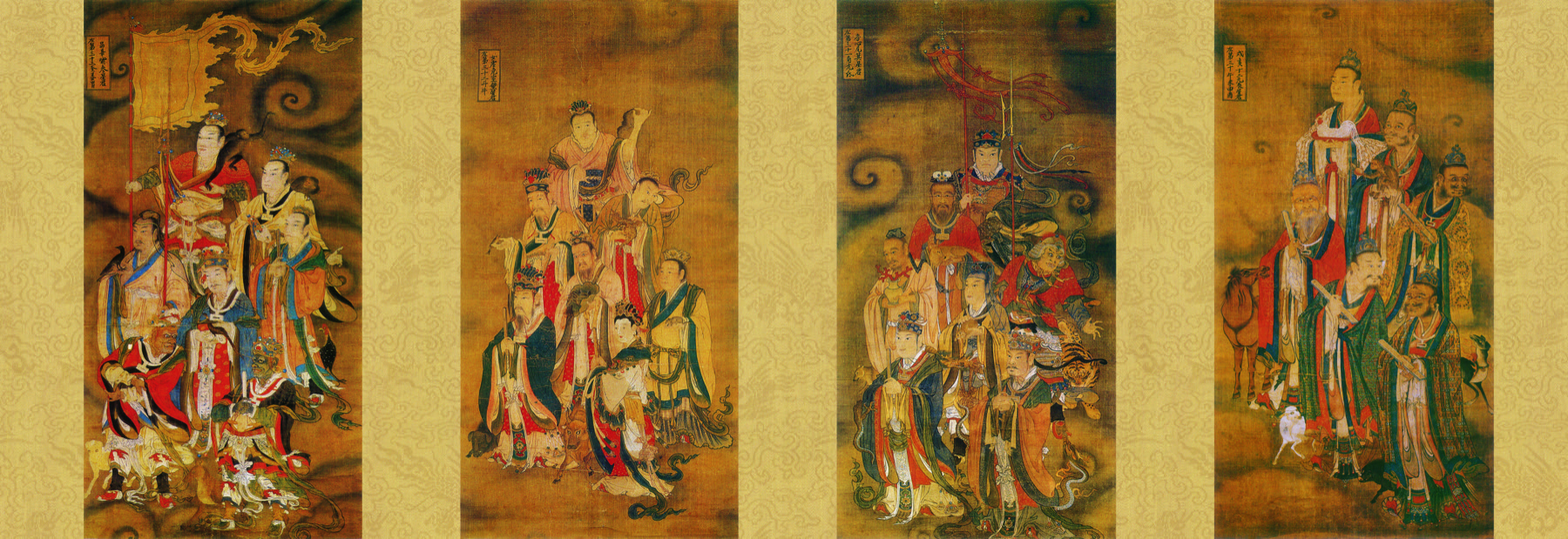
Quick answer: In TK0180, four tall groups of figures are divided by broad, pale patterned bands within a long horizontal image. These bands create visible pauses between dense scenes and help the eye distinguish one cluster from the next. Their exact original function—painted divider, textile-like field, or another design choice—cannot be established from this image alone.
What can be seen in TK0180?
TK0180 presents four vertical figure clusters across a wide horizontal field. Each cluster contains several people in varied robes and poses, while the pale patterned bands between them are comparatively open and quiet. The contrast is direct visual evidence: dense bodies and color gather within each panel-like area; lighter ornament occupies the intervals. The archive groups the image with a Shanxi Water-and-Land ritual painting handscroll, but that catalog context does not verify each figure’s identity or the historical role of each band.
At this scale, the repeated arrangement matters more than naming individual figures. A viewer can count four principal clusters, trace the three broad intervals between them, and notice that each interval is decorated rather than left blank. The image therefore offers a useful case for studying how a long composition can be segmented without a simple line or frame. The bands do not appear to be modern captions; they are part of the visual field shown in the supplied reproduction. Whether they belong to the original painted surface, a mounting, or the reproduction’s presentation requires examination of the object and its documentation.
How do the pale bands change the viewing experience?
The pale patterned intervals make the four clusters easier to distinguish. They interrupt the continuous dark, warm-toned background and provide a visual pause after a dense group of faces, garments, banners, and accessories. This is a description of their effect in the image, not a claim about a prescribed ritual sequence. The repeated alternation—figures, pale band, figures—encourages comparison across the strip while keeping each group locally legible.
Without those intervals, the adjacent figures could visually merge into one unbroken crowd. The bands instead mark boundaries through contrast, width, and pattern. Because they are broad, they do more than outline a single figure; because they repeat, they create a rhythm across the length of the image. That rhythm may help a viewer scan the long composition, but it does not by itself tell us how the work was originally displayed or handled.
The pattern also keeps each pause connected to the surrounding artwork. A blank gap would separate the clusters more sharply. Here, the pale ground carries its own repeating ornament, so the intervals remain active parts of the composition. They are quiet relative to the figure groups, but not visually empty. This combination of separation and continuity is the most reliable interpretive point available from the reproduction.
How to describe the divisions without overclaiming
A careful description distinguishes what the image shows from what a researcher might later infer. For TK0180, visible features include four tall clusters, broad light bands between them, repeated pale ornament, a continuous horizontal format, and differences in the colors and arrangements of the figures. The supplied archive title provides a contextual lead. It does not prove that the pale bands represent separate ceremonies, named deities, historical episodes, or physical joins in the scroll.
When recording a similar image, use a sequence like this:
- Map the whole. Note the image’s horizontal orientation and count the major clusters before inspecting small details.
- Mark boundaries. Record where each pale interval begins and ends, and whether it spans the full height of the visible field.
- Describe surface appearance. Note color, repeated pattern, contrast, and whether the interval seems continuous in the reproduction.
- Compare adjacent groups. Describe differences in density, pose, clothing colors, banners, and spacing without assigning names to uncertain figures.
- Separate observation from attribution. Put the archive label, object history, and any proposed function in a separate note, identifying the evidence supporting each claim.
This method is useful because it leaves room for future evidence. A high-resolution detail, a conservation report, a catalog entry, or an examination of the physical scroll could clarify whether a boundary is painted, textile, or related to mounting. Until then, “pale patterned divider band” is more accurate than “seam,” “chapter break,” or “ritual boundary.”
Are these bands seams, borders, or painted dividers?
The reproduction shows pale patterned bands, but it cannot establish that they are physical seams. A seam is a material join; confirming one would require evidence about the object’s construction, not just the appearance of a digital image. A border usually frames an image or a field, while these broad vertical intervals visually separate internal groups. “Divider band” is therefore a cautious descriptive term, not a definitive identification of material or purpose.
The bands’ patterned surface complicates the distinction. Ornament can appear on a painted ground, a textile, or another component, and a digital reproduction may flatten differences in texture. The photograph does not supply a cross-section, edge view, mounting record, or conservation description. Even a visible transition in color would not alone prove that two pieces of material were joined there.
It is also possible that the divisions were designed to organize the viewer’s attention. That is a reasonable reading of their compositional effect, but it remains an interpretation rather than a documented statement about the maker’s intention. A precise article should retain that distinction: we can say the bands segment the visible field; we cannot claim why the artist used them or how historical viewers understood them.
What should be compared across the four groups?
Comparison is most useful when it focuses on repeatable visual evidence. Begin with the number and relative width of figures, then compare the overall color balance and the presence of conspicuous objects such as standards or banners. Next, note whether each cluster has a dominant upright figure, seated figures, attendants, or overlapping poses. Some details in TK0180 are too small in this reproduction for confident identification, so names and attributes should remain uncertain unless supported elsewhere.
It is equally important to compare the intervals themselves. Are all the pale bands similar in width? Does the repeating pattern appear consistent? Do the bands interrupt the dark background in the same way? These questions can be answered from the image more safely than questions about symbolic meaning. If a better scan changes the apparent edges or reveals additional marks, update the description and record which version was examined.
Readers interested in a broader framework for separating observable details from iconographic or historical claims can consult the TANGKAWORLD Learn section. Its visual guides provide a starting point for describing composition while keeping uncertain identities and attributions explicit.
What remains uncertain?
The individual identities of the figures, the exact subject represented in each cluster, the bands’ material, their intended function, the scroll’s date, maker, workshop, lineage, collection, and provenance are all uncertain here. The archive grouping can be reported as catalog context, but the image alone cannot authenticate the full record. In particular, the words “Water-and-Land ritual” should not be used to infer that every group corresponds to a particular named ritual station or sequence.
Uncertainty is not a failure of looking. It is a way to keep a visual description trustworthy. Once the evidence is separated into what is plainly visible and what needs documentary support, researchers can ask more precise questions: Are the bands present in other images from the same handscroll? Do related reproductions show the same pattern? Does a catalog explain the scroll’s format? Is there physical evidence about joins or mounting? These are answerable research questions, but they require sources beyond this single image.
Frequently asked questions
How many figure groups are visible in TK0180?
Four principal vertical clusters are visible across the horizontal image, separated by three broad pale patterned intervals.
Do the pale bands prove that the handscroll has separate mounted sections?
No. The reproduction shows patterned bands, but it does not establish whether they are painted areas, textile, mounting components, or another feature.
Can the figures be identified from this image?
Not reliably from this reproduction alone. Individual names and roles remain uncertain unless corroborated by legible inscriptions or dependable catalog documentation.
Why call them divider bands?
“Divider band” describes their visible position and compositional effect without asserting their physical material or intended symbolism.
Sources and editorial method
This article is based on direct visual analysis of the TANGKAWORLD reproduction of TK0180. It records visible features—four figure clusters, broad pale patterned intervals, and the contrast between dense groups and quieter bands—separately from religious identification and historical attribution. The archive grouping is treated as catalog context rather than independent proof. Individual identities, material construction, date, maker, school, collection, provenance, and intended function remain uncertain unless confirmed by reliable documentation. For further visual-study resources, see Learn at TANGKAWORLD.
Prepared and reviewed by the TANGKAWORLD editorial team
Last reviewed: November 11, 2026

