Shanxi Water-and-Land Ritual Painting Handscroll 4 (TK0181): Stillness and Motion Across the Image
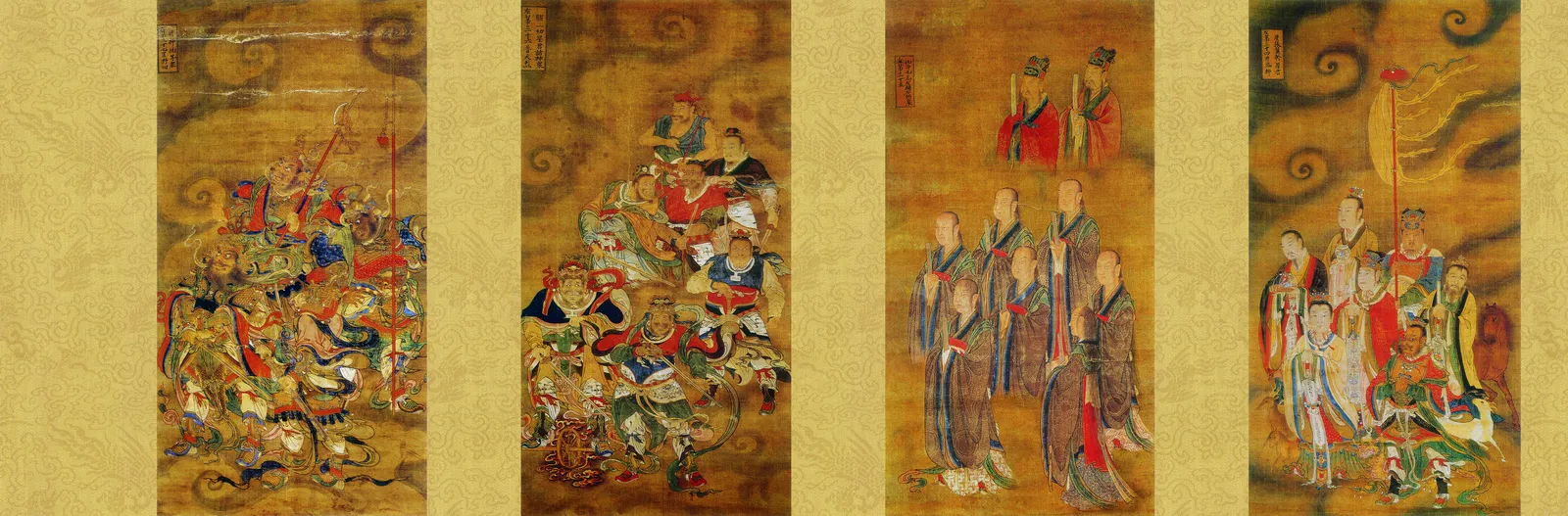
Quick answer: TK0181 creates a changing visual tempo through contrasting figure arrangements. Two sections appear crowded and energetic, with overlapping bodies, angled limbs, and flowing robes; another presents a more upright, measured group beneath two red-robed figures. These visible contrasts shape how the eye moves, but they do not identify the figures or prove a historical sequence.
What does “visual tempo” mean in TK0181?
Visual tempo describes how a composition alternates between busy and quieter passages, guiding attention through differences in pose, spacing, and direction. TK0181 offers a clear example: the left and center-left groups contain overlapping bodies and diagonal gestures, while the next group is arranged more vertically. The image’s sequence of dense and ordered areas creates a perceptible change of pace across its long format.
This is a description of the reproduced image, not a claim about music, performance, or the original handscroll’s viewing conditions. The catalog groups TK0181 with a Shanxi Water-and-Land ritual painting handscroll, but that archive label alone does not establish the subjects, the date, the maker, or the intended meaning of each grouping. In this article, “active,” “upright,” and “measured” refer only to visible arrangements.
The distinction is useful because a crowded multi-figure image can seem uniformly busy at first glance. Slowing down and comparing areas reveals that not every cluster uses the same pose language. Some figures lean or overlap; others stand in clearer vertical lines. Recognizing those formal differences lets a reader discuss the image’s rhythm without prematurely turning it into a named narrative.
Where does the image look most active?
The first two visible groups appear most active because their bodies overlap and their limbs, staffs, and long garments create diagonal or curling lines. In the left cluster, several figures are packed closely together; a tall standard rises through the group while robes and bodies cross at different angles. In the next cluster, figures lean inward and downward, with several forms layered over one another. The result is a dense field that invites the eye to move from one gesture to another.
“Active” does not mean that every figure is necessarily walking, fighting, or taking part in a particular event. A still painting can convey energy through bent knees, inclined torsos, crossing lines, and garments that extend beyond the body’s outline. In TK0181, these features are visible, but the specific actions and identities remain uncertain at the available image scale.
For a careful record, describe each cue separately: body angle, direction of a hand or object, overlap with nearby figures, and the way fabric trails or curves. Avoid compressing those details into one interpretive label such as “procession” or “battle” unless a reliable source confirms that reading. A viewer can note that a group feels unsettled or dynamic while leaving its story open.
Why does the third group feel more still?
The third group feels more still because many figures stand upright in a relatively clear row, with long robes falling close to vertical. Two smaller red-robed figures occupy the space above the larger lower gathering. Compared with the overlapping clusters to the left, this arrangement uses more parallel lines and more open separation between bodies. The shift in pose and spacing gives this area a measured, formal appearance.
That contrast is visible without naming the people. It would be tempting to call the upper pair rulers, deities, officiants, or teachers and the lower figures attendants, but the image alone does not establish those roles. Their relative position and clothing colors can be recorded; their social or religious identities should remain uncertain unless confirmed by legible inscriptions or dependable catalog documentation.
The upright robes also change the way the eye travels. Instead of following several diagonals through overlapping limbs, the viewer can move down the repeated vertical folds and across the standing figures. The result is a pause in the visual tempo, not necessarily a pause in the subject’s story. Composition can create a sense of order even when the historical relationship between groups is unknown.
How do banners and garments contribute to rhythm?
Long vertical standards and extended garments act as directional lines within TK0181. A standard interrupts the crowded left group with a tall upright accent; robes in the more active clusters curve and slant, while those in the formal gathering appear straighter. The contrast between vertical and diagonal forms is one reason the image feels varied rather than monotonous.
These lines can be mapped without deciding what an object symbolizes. Record where the standard begins and ends, which bodies it crosses, and whether it divides or visually connects nearby figures. For clothing, note the direction of hems, sleeves, and trailing fabric. If a contour is too small to distinguish from a neighboring figure, mark that boundary as unclear rather than filling it in from expectation.
A compact comparison of the visible groupings
Comparing the four areas makes the shift in tempo easier to explain. The table records only broad compositional cues visible in this reproduction; it does not assign names or narrative roles.
| Area | Visible arrangement | Possible viewing effect |
|---|---|---|
| Left group | Closely packed figures, crossing diagonals, and a tall standard | High energy; the eye changes direction often |
| Center-left group | Overlapping bodies, bent poses, and curving robe lines | Continues the sense of movement and density |
| Center-right group | Upright figures in a more legible row, with two red-robed figures above | A pause or formal interval in the visual rhythm |
| Right group | A mixed cluster beneath a large banner, with figures at different heights | Returns to a denser arrangement, but with a prominent vertical anchor |
The final area is important because the image does not simply progress from movement to stillness and stop. The rightmost group is again denser and includes a large banner, so the composition returns to a more complex arrangement. That return makes “tempo” a better description than a single one-way story: visual attention alternates between varied groupings rather than following a simple calm-to-action plot.
How to describe pose contrast without guessing the story
A repeatable description begins with spatial facts and then identifies the viewer’s likely visual response as an interpretation. For TK0181, use this sequence:
- Divide the view into broad groups. Use the pale intervals as neutral reference points, not as proof of separate historical episodes.
- Record posture. Note upright, leaning, seated, bent, or partially obscured forms only where the outline is clear.
- Trace directional lines. Mark standards, staffs, limbs, and garment edges that move diagonally or vertically through a group.
- Compare density. Estimate whether figures overlap tightly or have visible space around them.
- Separate effect from identity. Write “the group appears more orderly” before proposing why it is arranged that way.
- Keep a version note. Record the image file or crop examined, because a higher-resolution or differently framed reproduction may alter what can be seen.
This method keeps the analysis useful to another reader. Someone else can check whether the same bodies overlap, whether a robe line really curves, or whether the third group is more upright. By contrast, a claim about who the figures are or what ritual action they perform requires evidence beyond visual rhythm.
What remains uncertain?
The exact identities and roles of every figure, the subject of each group, the meaning of the standards, the relationship among the scenes, and the scroll’s original order and full extent remain uncertain. The archive title supplies a retrieval context, not independent proof of date, workshop, school, collection, provenance, or function. The image also cannot show how the original object was handled or whether the supplied digital sequence preserves its complete format.
It is reasonable to say that the composition contrasts intertwined poses with an upright assembly and that those differences alter the viewer’s attention. It is not safe to turn that observation into a fixed story without further documentation. The TANGKAWORLD Learn section offers broader visual-study resources for keeping description, religious identification, and historical attribution distinct.
Frequently asked questions
Which part of TK0181 appears most dynamic?
The first two visible groups appear most dynamic because bodies overlap and diagonal gestures, standards, and curving garments make the eye change direction.
Are the upright figures in the center-right group identified?
No. The image supports a description of their posture, clothing, and placement, but their individual identities and roles remain uncertain.
Does the image prove a sequence from action to calm?
No. The groups create a visual alternation, but the reproduction and archive label do not prove a narrative or ritual sequence.
Why call this visual tempo rather than movement?
“Visual tempo” includes both energetic and still arrangements; it describes how contrasts in pose and spacing change the pace of looking.
Sources and editorial method
This article is based on direct visual analysis of the TANGKAWORLD reproduction of TK0181. It separates visible evidence—overlapping poses, upright figures, diagonal and vertical lines, garment contours, and color contrast—from religious identification and historical interpretation. The archive grouping is retained as catalog context, not treated as verification. Names, roles, date, maker, school, collection, provenance, and narrative sequence remain uncertain unless supported by reliable documentation. For more visual-study resources, see Learn at TANGKAWORLD.
Prepared and reviewed by the TANGKAWORLD editorial team
Last reviewed: November 13, 2026

